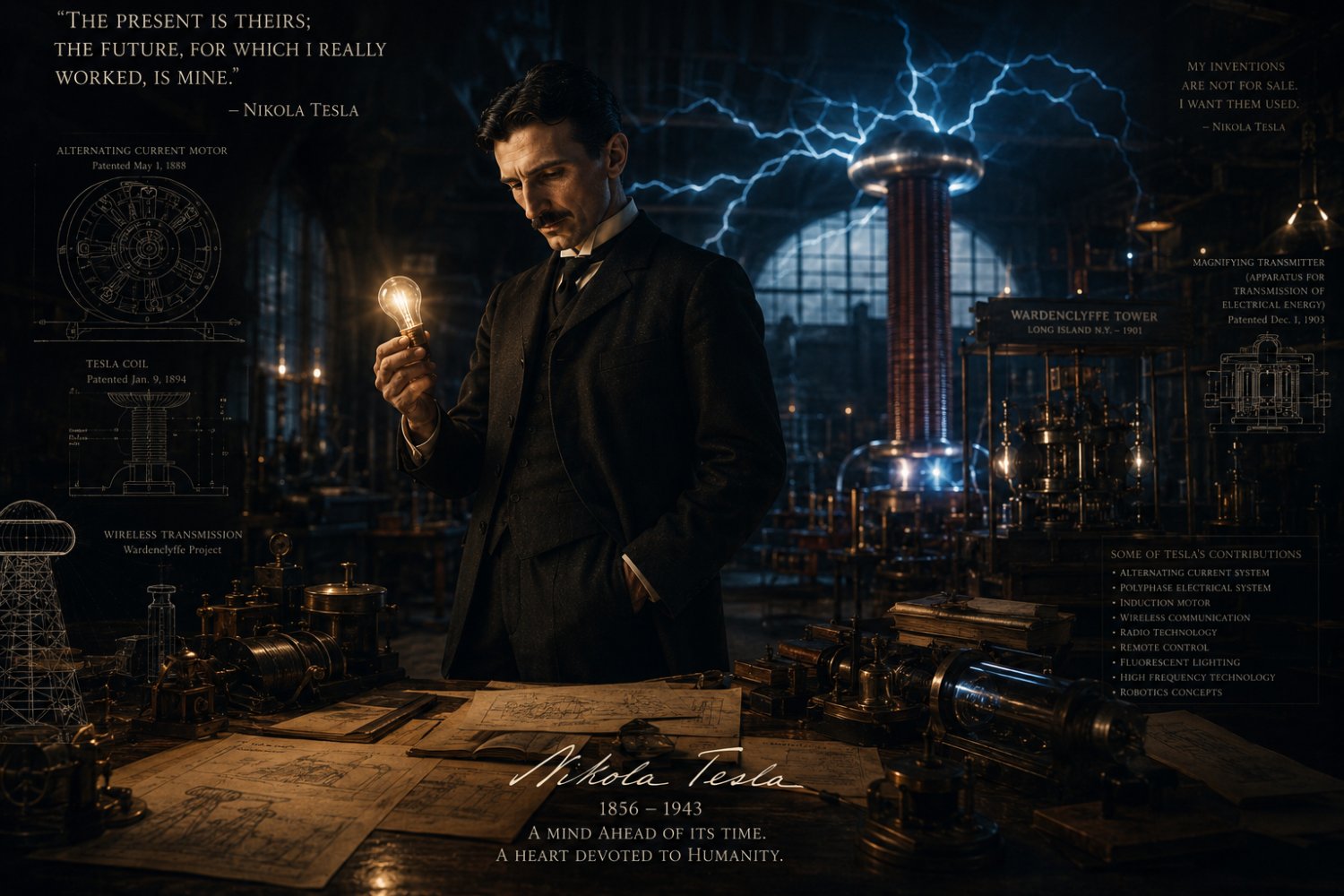
The Visionary Who Wanted to Advance Humanity
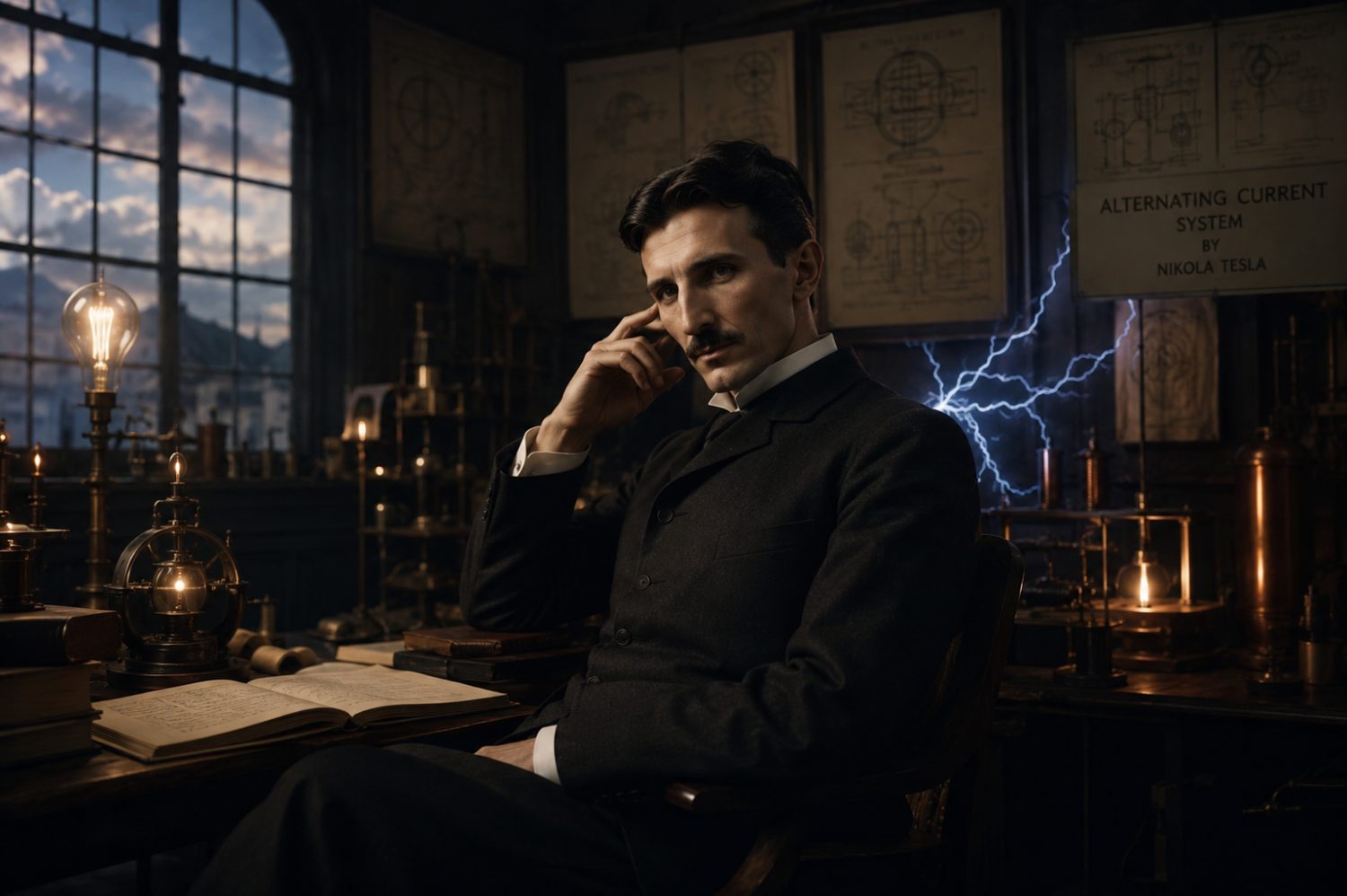
Introduction
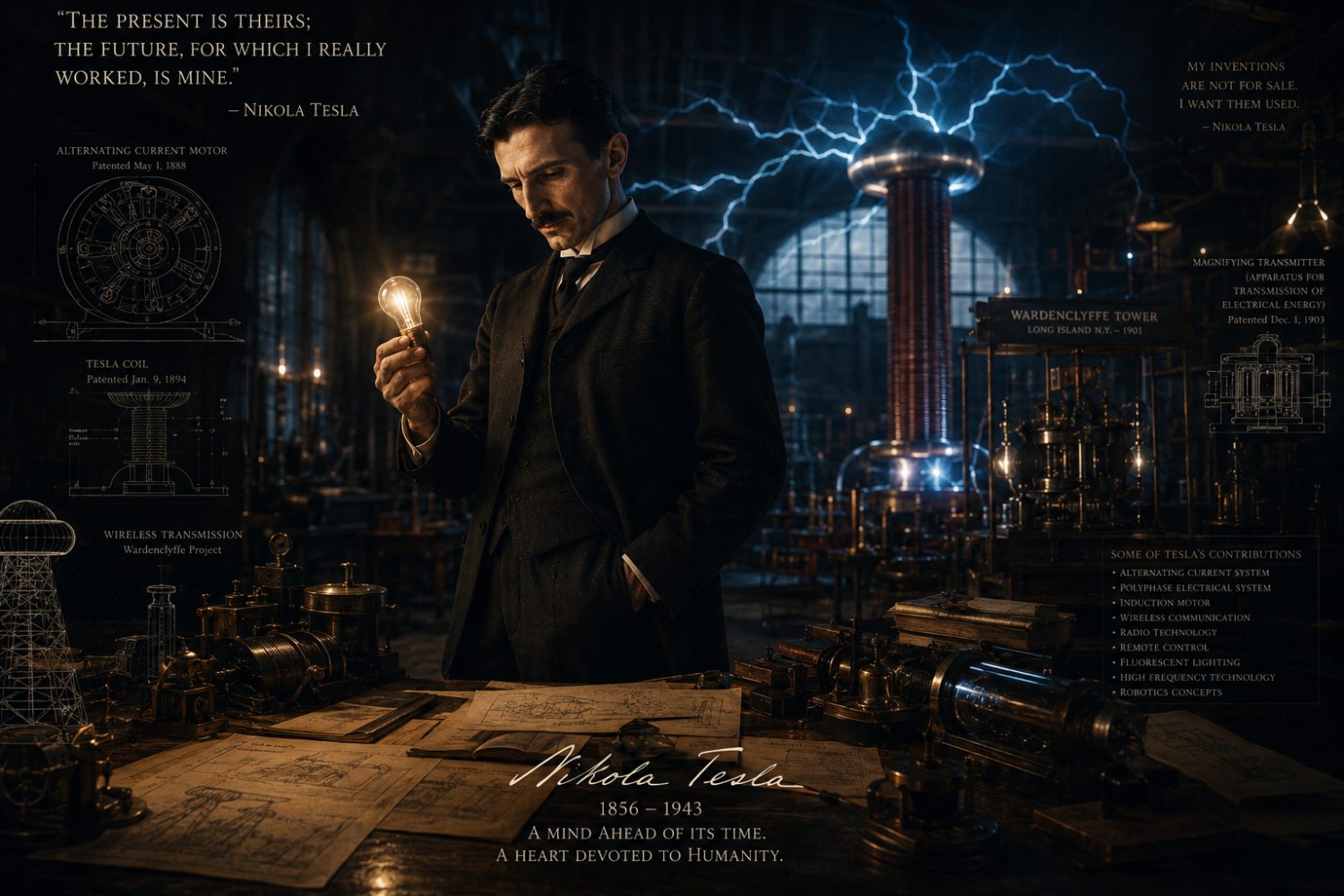
Among the greatest inventors in human history, Nikola Tesla stands in a category of his own. Many scientists changed the world through discovery, and many businessmen transformed industries through profit and organization, but Tesla became famous for something deeper: he appeared genuinely driven by the desire to improve civilization itself.
Tesla was not simply interested in making machines. He was interested in making humanity more advanced, more connected, and more efficient. Unlike many industrial figures of his time, he often showed little concern for personal wealth, luxury, or political power. His imagination constantly focused on what humanity could become if science and technology were used wisely.
Even decades after his death, Tesla remains one of the most admired inventors ever because his ideas often seemed far ahead of his era. Many technologies now common in modern life reflect concepts he imagined long before the world was technologically ready for them.
Early Life and Education
Nikola Tesla was born on July 10, 1856, in Smiljan, a village that was then part of the Austrian Empire (modern-day Croatia). He was born into a Serbian family. His father was a priest, while his mother, although not formally educated, possessed remarkable practical intelligence and could create mechanical tools and household devices.
Tesla inherited strong intellectual abilities from both parents. From an early age, he displayed extraordinary memory and imagination. He could mentally visualize complicated machines in great detail without drawing them physically. This ability later became one of the foundations of his inventive genius.
As a student, Tesla excelled in mathematics and physics. He developed a fascination with electricity, which at the time was still a developing field full of mystery and experimentation.
The Vision of Electricity
During Tesla's lifetime, electricity was beginning to reshape the world. However, the systems available were inefficient and limited. The dominant electrical system promoted by Thomas Edison used direct current (DC), which could not efficiently transmit electricity over long distances.
Tesla believed there was a better approach.
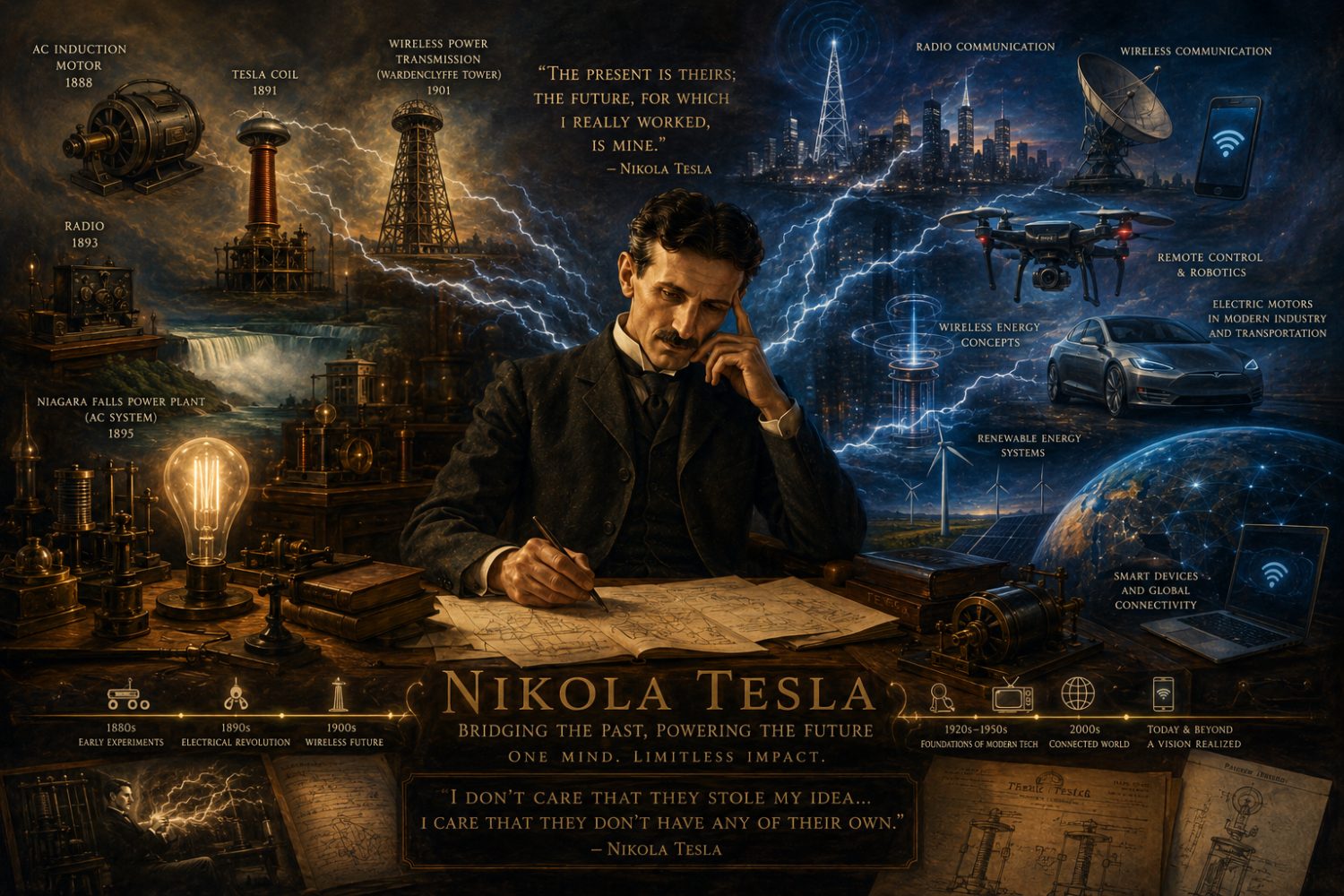
He developed and promoted alternating current (AC), a system capable of carrying electricity across vast distances with much greater efficiency.
P=VIP = VIP=VI
This breakthrough transformed modern civilization. Today, AC power systems remain the global standard for electrical transmission.
Tesla's ideas eventually gained support from industrialist George Westinghouse, leading to one of the most important technological revolutions in history. The success of AC power helped electrify cities, industries, and homes around the world.
Without Tesla's contributions, the modern electrical age would likely have developed far more slowly.
A Mind Far Ahead of Its Time
Tesla's imagination extended far beyond electricity transmission. He envisioned technologies that sounded impossible during his lifetime but later became reality.
Some of the ideas he explored included:
- Wireless communication
- Remote-controlled machines
- Robotics concepts
- Wireless energy transmission
- High-frequency electrical systems
- Advanced lighting systems
- Automation
- Global communication networks
At a time when many people still lived without electric lighting, Tesla was already imagining a connected technological civilization.
One of his most remarkable demonstrations involved remote-controlled boats, which amazed audiences because most people had never seen machines operate without direct human contact. Today, remote control technology is everywhere from drones to wireless devices.
Tesla also predicted systems resembling modern smartphones and wireless communication decades before they existed.
The Desire to Improve Humanity
What separates Tesla from many inventors is the philosophy behind his work.
He often spoke about reducing human suffering, eliminating unnecessary labor, and using technology to advance civilization. His inventions were not only technical achievements; they reflected his belief that science should elevate humanity.
Tesla dreamed of:
- Free or inexpensive access to energy
- Better communication across nations
- Technological cooperation
- Reduced conflict through scientific progress
- A more intelligent and efficient civilization
This idealistic mindset is one reason so many people admire him today. He appeared less interested in personal control and more interested in the future of humanity itself.
Unlike some industrial leaders, Tesla did not aggressively build monopolies or political empires around his inventions. In fact, his lack of business aggression often worked against him financially.
Wardenclyffe Tower and the Dream of Global Energy
Perhaps the greatest symbol of Tesla's ambition was the Wardenclyffe Tower project.
Tesla envisioned a massive wireless transmission system that could send information and possibly electrical energy across long distances without traditional wires.
At the time, the idea seemed almost unbelievable. Investors became uncertain about the financial benefits of such a system, especially if energy distribution became difficult to monetize.
Eventually, funding disappeared, and the project failed.
Yet many people continue to see Wardenclyffe Tower as evidence of Tesla's extraordinary vision. Whether or not all aspects of the project would have succeeded scientifically, the ambition behind it demonstrated how differently Tesla thought compared to ordinary businessmen.
He was attempting to design systems for civilization itself, not merely products for profit.
Weaknesses and Personal Struggles
Although Tesla was brilliant, he was not perfect.
He struggled with:
- Financial management
- Business negotiations
- Practical commercial strategy
- Social isolation
- Obsessive work habits
As he grew older, some of his ideas became increasingly speculative and difficult to prove scientifically. He also became isolated from mainstream scientific communities.
Tesla's intense dedication to invention sometimes separated him from ordinary human relationships. He rarely pursued family life and devoted nearly all his energy to work and thought.
In his later years, he lived in relative poverty despite helping create technologies worth billions of dollars.
Rivalry with Edison
Tesla's conflict with Thomas Edison became one of the most famous rivalries in technological history.
Edison represented practical industrial capitalism and commercial expansion. Tesla represented visionary scientific imagination.
While Edison focused heavily on building profitable systems and controlling industries, Tesla often appeared more interested in the long-term possibilities of technology.
Their rivalry during the War of Currents symbolized two different approaches to progress:
- One centered on commercial dominance
- The other centered on technological advancement and idealism
Although history remembers both men as important innovators, Teslau2019s image later became especially admired because many people viewed him as less motivated by greed or personal power.
Death and Legacy
Nikola Tesla died alone in a hotel room in New York City on January 7, 1943.

At the time of his death, some people viewed him as an eccentric forgotten inventor. However, history gradually restored recognition to his achievements.
Today Tesla is celebrated worldwide as:
- One of the greatest inventors in history
- A pioneer of modern electrical systems
- A visionary thinker ahead of his time
- A symbol of scientific imagination
- An example of innovation directed toward humanity
Modern engineers, scientists, entrepreneurs, and students continue to study and admire his work.
Even the electric vehicle company Tesla, Inc. was named in his honor, reflecting his enduring influence on technological progress.
Why Nikola Tesla Remains a Mentor Figure
Nikola Tesla remains inspirational because his life represents more than intelligence.
He demonstrated:
- Vision beyond immediate profit
- Dedication to innovation
- Belief in human advancement
- Scientific imagination
- Sacrifice for ideas larger than himself
He reminds people that technology can be used not only to create wealth, but also to improve civilization itself.
Tesla's greatest legacy may not simply be the machines he invented, but the mindset he represented the belief that human intelligence should be used to push humanity toward a better future.
That is why, even more than a century later, Nikola Tesla continues to stand as one of history's most extraordinary and admired visionaries.