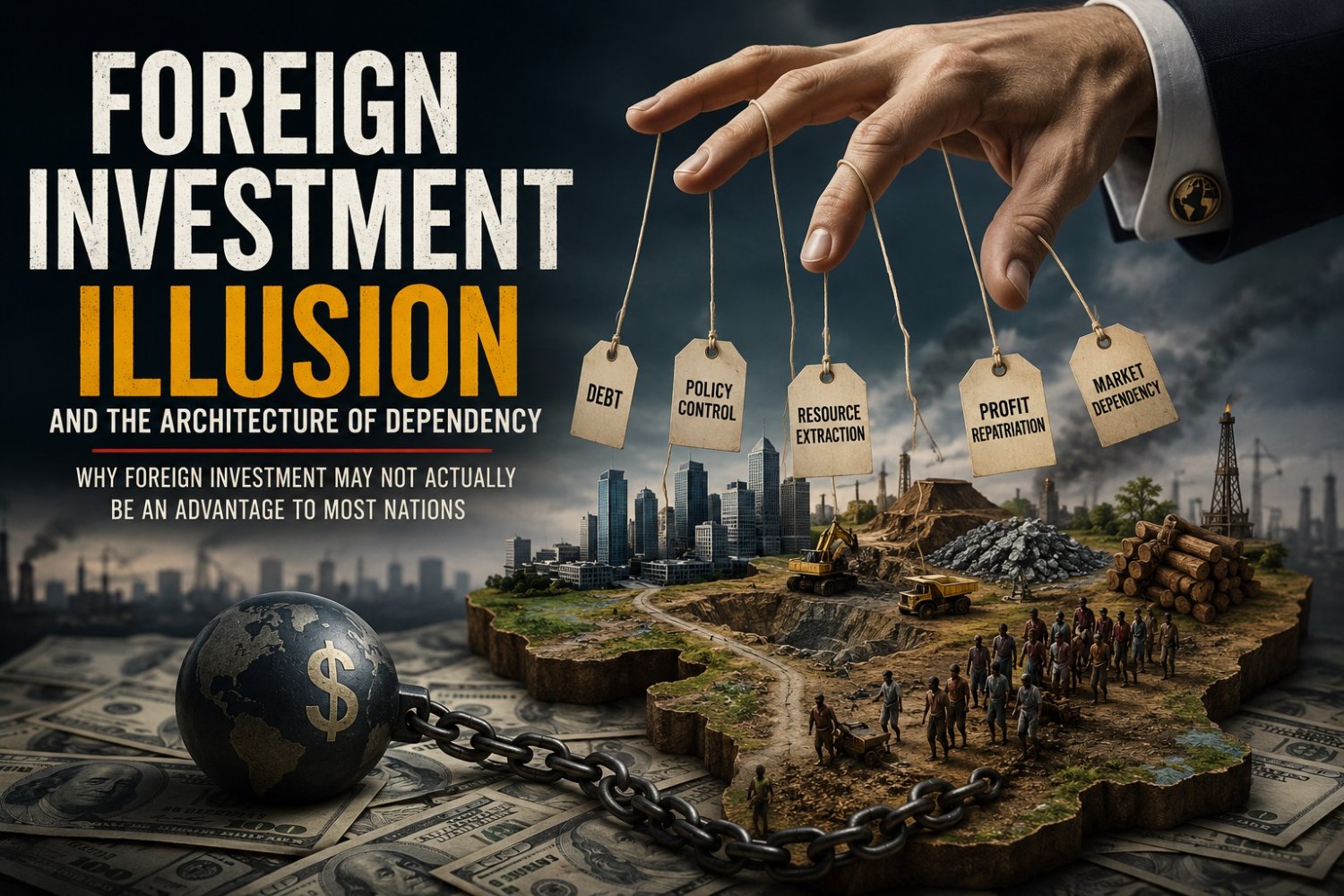
Why Foreign Investment May Not Actually Be an Advantage to Most Nations

Introduction
Foreign investment is widely promoted as a necessary ingredient for national development. Governments compete aggressively to attract external capital, international institutions encourage market liberalization, and multinational corporations present themselves as engines of modernization. In many developing countries, the arrival of foreign investors is treated as proof that economic progress is taking place.
However, the assumption that foreign investment automatically benefits a nation deserves deeper examination. While foreign capital can produce visible economic activity, it does not always produce genuine national development. In many cases, foreign investment may actually weaken a country's long-term ability to develop independently by distorting its natural economic evolution, increasing dependency, and placing strategic sectors under external influence.
These dangers become even more severe under unfocused leadership systems — governments that lack long-term national vision, institutional discipline, developmental clarity, or strategic coordination. In such environments, foreign investment can evolve beyond ordinary economics and become a mechanism through which external networks gradually capture national direction itself.
The central issue is not simply profit extraction. Rather, it is the possibility that foreign investment can redirect a nation's original developmental trajectory while simultaneously weakening its internal sovereignty.

1. The Concept of an Original Developmental Trajectory
Every country possesses an original developmental trajectory — a natural path of growth that would likely emerge if the nation evolved primarily according to its own environmental conditions, resources, productive capabilities, population structure, geography, and social realities.
Over time, societies naturally develop systems adapted to their internal needs. Industrial patterns, technological priorities, agricultural structures, governance systems, and economic institutions usually emerge from local pressures and local experience. Nations gradually build productive systems suited to their own realities.

Development in this sense is not merely economic growth. It is the gradual accumulation of internal capability, institutional maturity, technological competence, and strategic independence.
However, under weak or unfocused leadership, national developmental direction becomes unstable. Instead of following internally generated priorities, governments become reactive, short-term, and externally dependent. In such situations, foreign actors often begin shaping national priorities indirectly through capital influence.
The country's original developmental trajectory is gradually replaced by externally engineered economic behavior.

2. How Foreign Investment Can Distort National Development
Instead of developing industries based on national priorities, economies may begin reorganizing themselves around external interests. Foreign corporations often invest in sectors that maximize their own strategic advantage rather than sectors most important for long-term national independence.
As a result, a country may become heavily involved in extraction, assembly, consumption, or low-level production while failing to build advanced domestic capacity.
This creates a dangerous illusion of development.
Infrastructure may expand. Cities may modernize. Employment may increase temporarily. GDP figures may rise. Yet beneath these visible signs of progress, the nation may remain structurally weak. Critical industries may still depend on foreign technology, foreign financing, foreign management, and foreign supply chains.
Under an unfocused leadership system, governments may mistake economic activity for genuine development. Short-term visibility replaces long-term capability building. Leaders begin prioritizing projects that create immediate political appearance rather than projects that build independent national strength.
Local firms struggle to compete against multinational corporations with superior capital and global influence. Domestic innovation weakens because the most profitable sectors are already dominated externally.
In such conditions, economic growth does not necessarily translate into economic sovereignty.
3. The Creation of Long-Term Dependency
Foreign investment can create systems of long-term dependency when national survival becomes tied to continued external participation.
Once a nation's economy becomes reliant on external capital inflows, policymakers may begin designing national decisions around the preferences of foreign investors rather than the long-term interests of citizens. Governments may offer excessive concessions, weaken regulations, privatize strategic assets, or suppress local industries in order to maintain investor confidence.
Over time, the country becomes trapped in a cycle where it cannot sustain itself without continued foreign participation.
This dependency extends beyond economics. Political institutions themselves may gradually adapt to protect foreign economic relationships. State priorities shift from building domestic productive strength to maintaining external approval and investor confidence.
Under weak leadership systems, dependency can become institutionalized because leaders themselves begin relying on external validation for political survival. Foreign investment therefore stops functioning merely as capital and begins functioning as political leverage.

The result is a nation that appears economically active while remaining structurally dependent underneath.
4. Effects on National Security and Internal Coordination
Foreign investment can also affect internal security coordination and national stability when strategic sectors fall under heavy external influence.
When telecommunications, financial systems, ports, mining operations, energy infrastructure, or technological networks become externally dependent, the state may gradually lose full operational control over systems critical to national coordination.
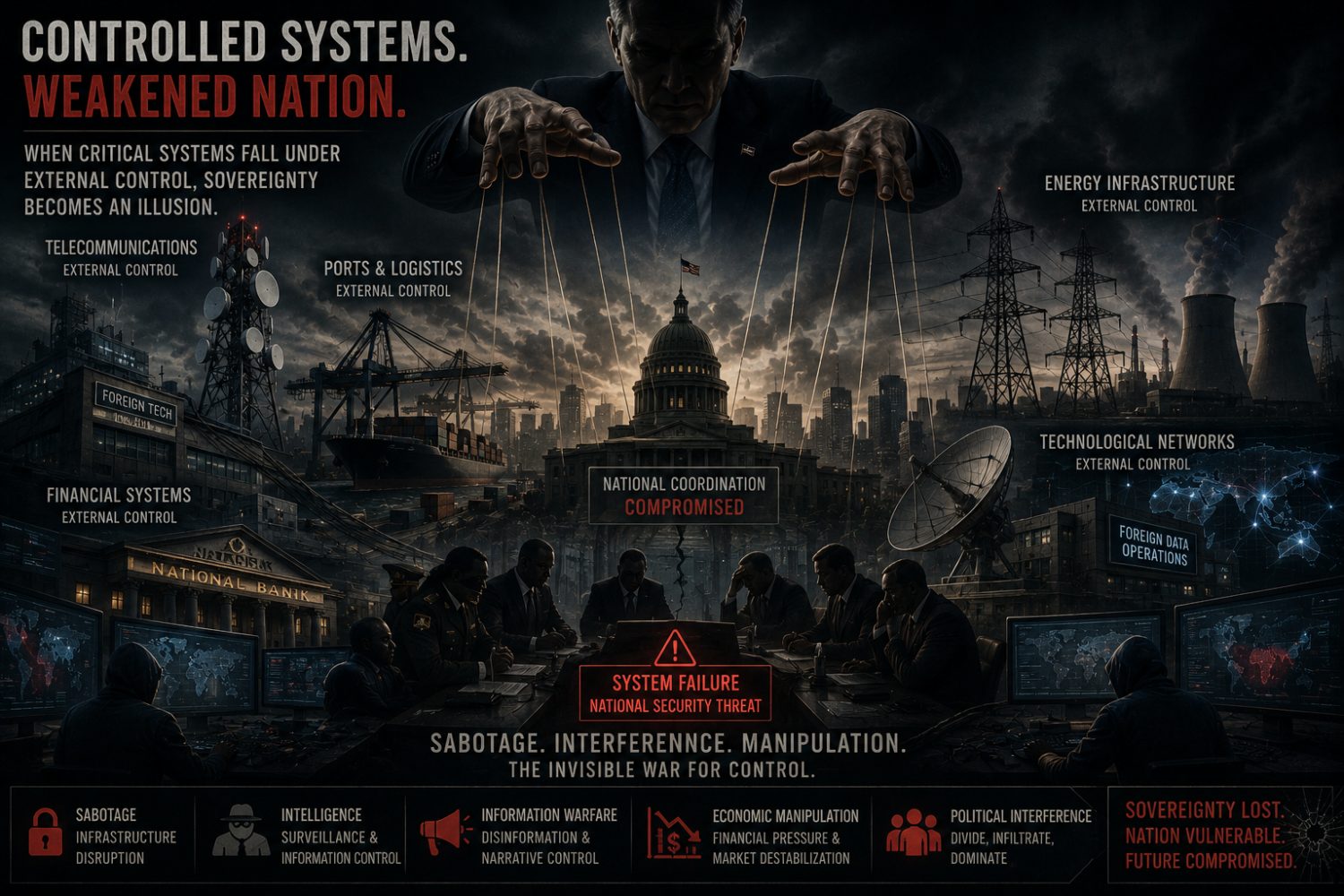
A nation whose communication systems, logistics networks, or technological infrastructure are heavily tied to foreign entities becomes vulnerable during periods of political disagreement or geopolitical conflict. External actors may indirectly influence national stability through control over technology access, infrastructure maintenance, intelligence support, or financial coordination.
In extreme situations, a country may discover that essential parts of its economy and governance cannot function effectively without external cooperation.
This weakens sovereignty because national coordination itself becomes partially outsourced.
Under weak leadership, this vulnerability becomes even more dangerous because institutions are often poorly coordinated internally. External actors can exploit divisions between political elites, security agencies, financial institutions, and regulatory bodies to expand influence inside the national system.
5. The Danger of Sudden Foreign Withdrawal: The Case of Guinea
History also shows the dangers of sudden foreign withdrawal after dependency has already been created.
A major example occurred in Guinea after it voted for immediate independence from France in 1958 under the leadership of Ahmed Sékou Touré.

Unlike other French West African territories, Guinea rejected continued integration within the French Community. France responded aggressively. French administrators, engineers, teachers, technicians, and civil servants were rapidly withdrawn from the country. Development assistance was halted almost immediately. Reports from the period also describe French officials dismantling or removing equipment and administrative infrastructure before departure.
The sudden withdrawal exposed how dangerous externally dependent systems can become. Key administrative, technical, and institutional functions within Guinea had been structured around French control rather than indigenous national capacity. Once those systems were removed, Guinea faced severe economic and administrative disruption.
The situation escalated further when France allegedly engaged in destabilization efforts after Guinea attempted to establish independent monetary and political systems. Historical accounts surrounding “Operation Persil” describe attempts to undermine Guinea’s economy through counterfeit currency operations and support for destabilizing activities.
This case illustrates an important reality about foreign dependency: when a nation relies too heavily on externally controlled expertise, infrastructure, finance, or administrative coordination, sudden withdrawal can create internal instability, economic paralysis, and weakened state coordination. Development that is not internally rooted may therefore become structurally fragile.
6. Foreign Investment and Political Manipulation
Foreign investment can generate political distortion inside the host nation itself.
Large foreign investors often gain extraordinary leverage over policymakers because governments fear losing external capital inflows. Over time, this can encourage political systems to prioritize investor interests over national interests.
In some cases, foreign corporations or aligned external powers may attempt to influence internal governance in order to maintain favorable conditions for extraction, taxation privileges, resource access, or geopolitical relevance.
Policies may no longer emerge primarily from national developmental needs but from the necessity of maintaining foreign approval and capital retention.
Under unfocused leadership systems, political elites may gradually become intermediaries between external interests and domestic institutions. National leadership becomes reactive rather than strategic.
This creates a dangerous situation where domestic governance gradually becomes externally conditioned.
7. Foreign Investment as a Mechanism for Capital Flight
Another overlooked problem is the use of foreign investment structures for elite capital flight and wealth laundering out of the national system.
Political and economic actors within developing nations may collaborate with foreign financial or corporate structures to move public wealth abroad under the appearance of legitimate investment, procurement, consultancy arrangements, debt servicing, or multinational partnership agreements.
Under such systems, national wealth leaves the country while appearing statistically as economic activity.
A country may record high levels of investment while simultaneously suffering from weakened domestic capital accumulation. Local productivity declines because wealth generated internally is continuously transferred outward rather than reinvested into national industrial growth, scientific development, infrastructure maintenance, or technological advancement.

Under weak leadership, foreign investment structures can therefore become channels through which ruling elites externalize national wealth while presenting themselves domestically as promoters of development.
In this way, foreign investment can become not merely an economic tool, but an institutional mechanism for preserving underdevelopment.
8. The Emergence of Foreign-Linked Influence Networks
In extreme situations, foreign economic influence can evolve into something resembling a transnational influence network operating above the nation itself.
Under weak governance systems, certain foreign-linked economic structures may gradually penetrate politics, finance, media, resource management, security coordination, and elite decision-making simultaneously. Instead of merely investing in the country, these networks begin integrating the country into a larger external system of influence and extraction.
The danger is not always formal occupation or direct colonialism. It is the gradual hijacking of national direction.
Political elites may become financially tied to external networks. Strategic sectors may become dependent on foreign-controlled systems. Domestic institutions may lose the ability to act independently because too many internal actors benefit from maintaining external control arrangements.
At this stage, the nation risks functioning less as an independent sovereign entity and more as a subordinate node within a larger transnational power structure.
The result resembles a form of economic and political capture where national priorities are continuously adjusted to serve external strategic interests while the local population bears the long-term consequences.
9. The Illusion of Development
The tragedy is that all of this can occur while surface indicators appear positive.
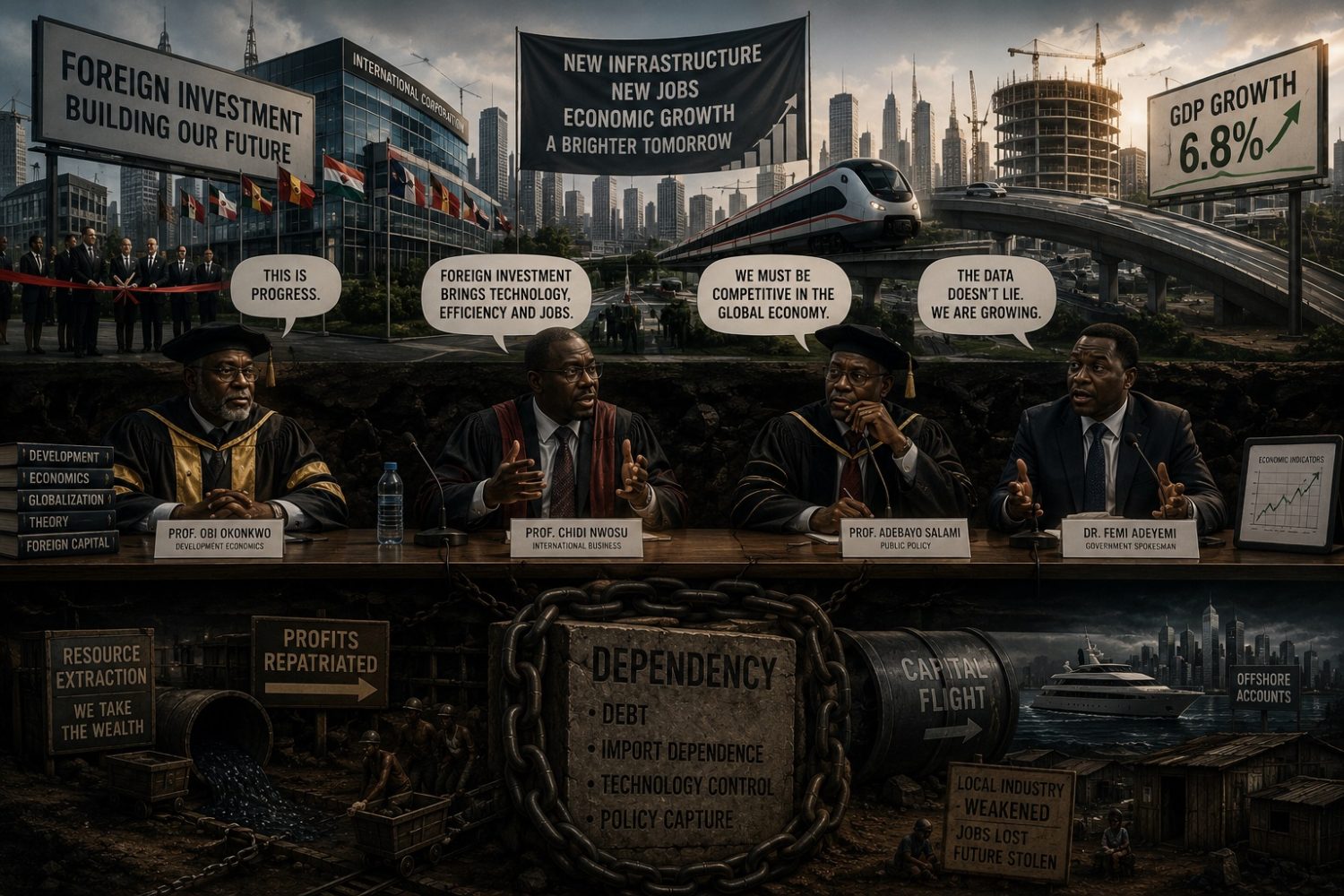
New infrastructure projects emerge. Foreign companies establish offices. Urban expansion accelerates. Economic statistics improve. Yet underneath the appearance of modernization, the country may be losing control over its developmental direction, productive systems, financial sovereignty, and strategic independence.
A nation can therefore become economically active without becoming economically powerful.
Under unfocused leadership, appearances often replace structural development. Nations begin measuring success by external inflows instead of internal capability.
Conclusion
This does not mean all foreign investment is harmful. External capital can contribute positively when it operates within a strong national framework that protects domestic interests, builds local capability, encourages technology transfer, and preserves strategic independence.
The problem arises when foreign investment becomes a substitute for internal development rather than a tool that supports it.
Under weak leadership systems, the danger becomes far greater because foreign capital can gradually evolve into external influence over national direction itself.
The true measure of development is not how much foreign money enters a country, but whether the nation becomes more capable of sustaining itself, controlling its strategic sectors, coordinating its own internal systems, and directing its own future without external dependency.
A country that cannot survive without external control may appear developed on the surface while remaining dependent underneath.