Introduction
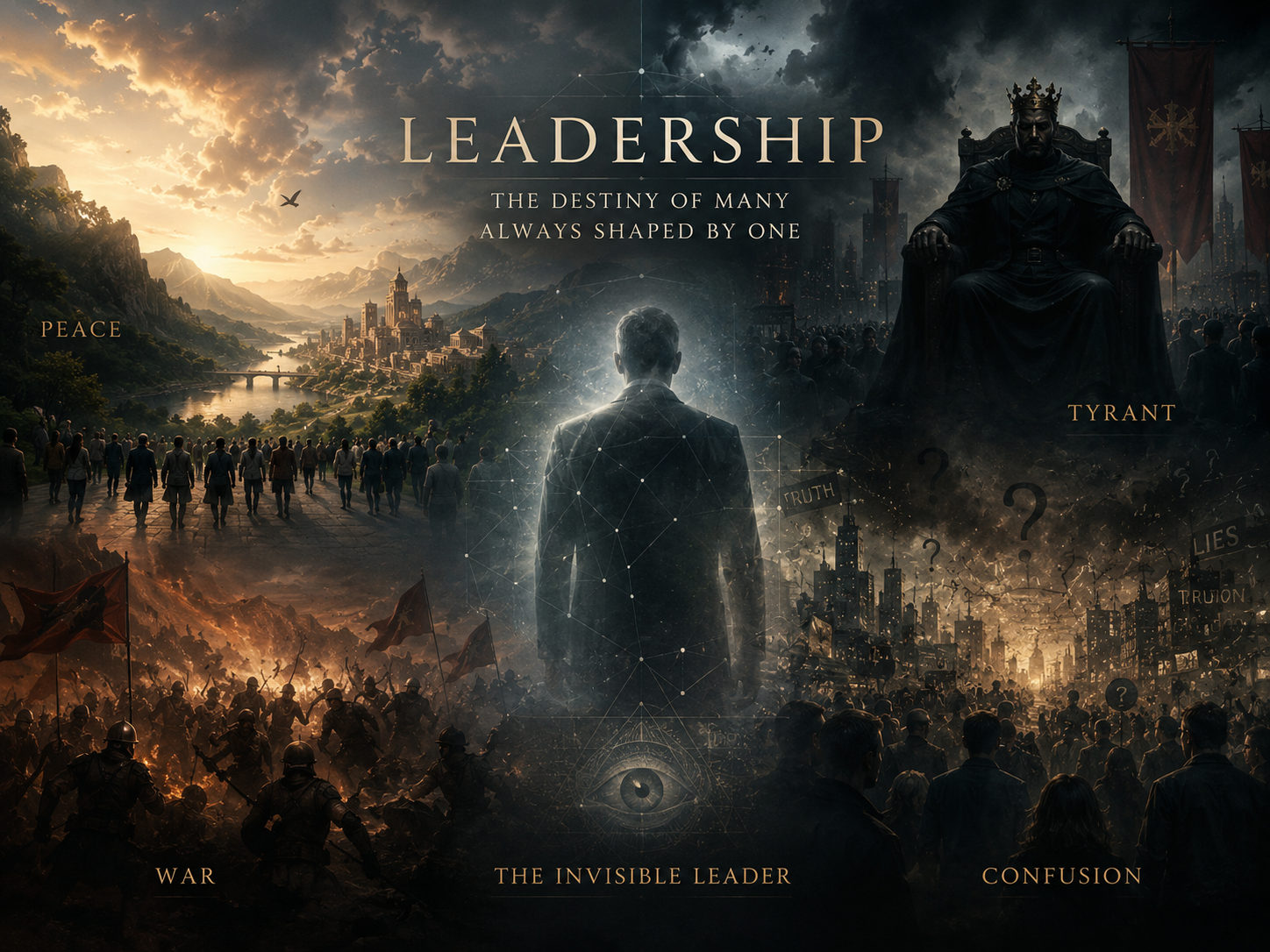
Leadership has never been merely a social title.
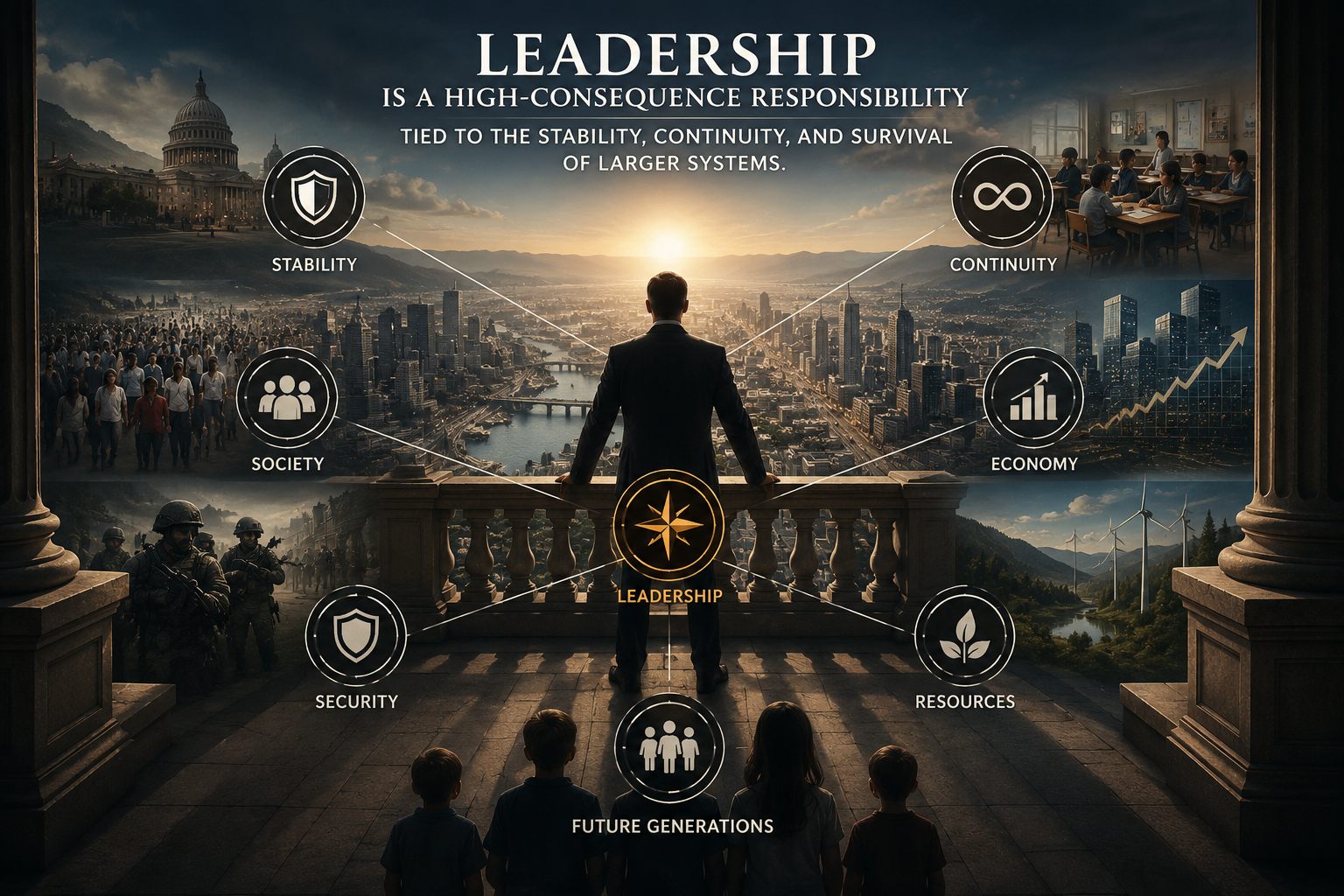
In every functioning civilization, leadership is a high-consequence responsibility tied directly to the stability, continuity, and survival of larger systems.
A leader influences:
- institutional direction,
- public behavior,
- economic continuity,
- social confidence,
- and long-term strategic outcomes.
The higher the authority, the greater the amplification of personal character into public consequence.
For this reason, societies throughout history developed formal and informal filters for leadership selection. Some emphasized wisdom, others discipline, lineage, military competence, moral reputation, or administrative capacity. The standards differed across civilizations, but the underlying problem remained similar:
Who should be trusted with power?

One principle has repeatedly emerged from this question:
Individuals lacking sufficient internal regulation represent a higher risk when placed in positions of authority.
The reason is simple. Leadership does not remove the character of the individual who holds it. It amplifies it.

Modern society, however, increasingly evaluates leadership through visibility rather than stability, charisma rather than restraint, and stimulation rather than long-cycle responsibility.
This creates a growing mismatch between the psychological demands of leadership and the personalities increasingly elevated into positions of authority.
The consequences of this mismatch are becoming structurally visible.
Leadership as a Functional Responsibility
Leadership should not be understood primarily as status, popularity, or symbolic influence.
It is a functional responsibility.
A leader operates within conditions of pressure, uncertainty, incomplete information, competing interests, and consequences that often extend far beyond the original decision.
Under these conditions, the internal structure of the leader becomes important.
A leader unable to regulate impulses privately may eventually struggle to regulate power publicly.
This is not primarily a moral accusation.
It is a systems observation.
In a low-impact environment, impulsive behavior may produce consequences limited largely to the individual. In high-amplification environments such as government, military command, corporate leadership, institutional management, or technological governance, the same instability can scale into systemic damage.
The issue is therefore not pleasure itself.
The issue is the absence of sufficient regulation over appetite, impulse, and stimulation when authority is involved.
A person may enjoy pleasure without being governed by it.
That distinction is fundamental.
Historical Precedent and Civilizational Patterns
Civilizations rarely decline because of one decision or one individual alone.
Decline is usually a process.
Institutional discipline weakens. Short-term interests begin to dominate long-term planning. Leadership becomes increasingly reactive. Corruption becomes normalized. Public confidence declines. Social divisions deepen.
Among the recurring characteristics associated with stable leadership are restraint, continuity, duty, delayed gratification, and responsibility beyond immediate self-interest.
These qualities are not exclusive to any particular political system or culture.
They represent a basic requirement of maintaining order across time.
The opposite condition is equally important.
When leadership becomes increasingly dominated by indulgence, spectacle, immediate gratification, personal validation, or uncontrolled appetite, the authority of the individual can begin to compete with the interests of the system.
The problem is not that leaders are human.
The problem begins when the demands of the individual become more important than the responsibilities attached to the position.
The Modern Stimulation Environment
The current era introduces a condition that previous civilizations did not experience at a comparable scale:
unlimited stimulation.
Digital systems compete continuously for attention, emotional reaction, engagement, recognition, and psychological immersion.
Pleasure is increasingly available on demand.
Information is continuous.

Public approval can be measured instantly.
Disapproval can be received instantly.
A person can be surrounded by stimulation without ever leaving the same room.
This changes the leadership problem.
The future threat to governance may not be defined primarily by a lack of information.
There may be too much information.
The greater problem may become the inability of authority figures to maintain internal stability while operating inside systems designed to capture attention and influence behavior.
In such an environment:
- emotional reactivity can become political strategy;
- visibility can replace depth;
- public validation can replace internal conviction;
- short-term stimulation can override long-term responsibility.
The result is a leadership culture increasingly vulnerable to external influence.
The individual who cannot regulate himself becomes easier to regulate by others.

Consequences of Leadership Failure

When psychologically unregulated individuals occupy high-amplification positions, the resulting failures extend beyond personal misconduct.
The consequences can include:
- institutional inconsistency,
- policy volatility,
- public distrust,
- reactionary governance,
- corruption vulnerability,
- strategic discontinuity,
- and societal fragmentation.
The damage does not necessarily remain within the institution where the failure began.
It can travel into the nation, the community, the family, the economy, and eventually the generation that inherits the consequences.
This is one of the defining characteristics of leadership.
Its effects propagate.
A private weakness can become a public structure.
A poor personal decision can become an institutional policy.
An unstable personality can create an unstable organization.
A leadership failure can therefore become a continuity problem.
The damage becomes even greater when technological systems amplify leadership behavior instantly across large populations.
Modern civilization is increasingly interconnected.
As a result, leadership instability can propagate faster and farther than at any previous point in history.

The psychological condition of leadership is therefore no longer merely personal.
It is infrastructural.
Toward a Leadership Filtering Framework
The emerging challenge for future societies is not simply the selection of intelligent leaders.
Intelligence is necessary, but it is insufficient.
A leadership system must also identify individuals capable of maintaining internal order while operating under pressure.
Relevant characteristics include:
- impulse resistance,
- long-cycle thinking,
- emotional regulation,
- low dependence on external validation,
- consistency under pressure,
- responsibility toward institutions,
- and the capacity to accept necessary limits.

These qualities do not guarantee good leadership.
They reduce particular forms of leadership risk.
Future governance systems may therefore require leadership filtering models similar to stress-testing systems used in engineering and infrastructure.
A structure expected to carry enormous weight is tested before the weight is placed upon it.
Authority should be treated in much the same way.
The central question becomes:
Can this individual maintain internal order while operating inside a high-pressure, high-stimulation environment?
If the answer is no, the risk does not end with the individual.
It transfers to the system.
Conclusion
The future of governance may depend less on ideological competition and more on psychological durability.

Civilizations built under conditions of scarcity required productive leadership.
Civilizations emerging under conditions of continuous stimulation may require regulated leadership even more urgently.
This does not require the elimination of freedom, pleasure, individuality, or ambition.
It requires something more fundamental:
the preservation of responsibility within authority.
A society cannot remove human nature from its leaders.
It can, however, become more deliberate about which aspects of human nature it chooses to place in positions of amplified consequence.
The question for future governance is therefore not simply who is capable of obtaining power.

It is:
Who is capable of holding power without being governed by appetite, stimulation, or impulse?
That distinction may become one of the defining governance questions of the coming century.