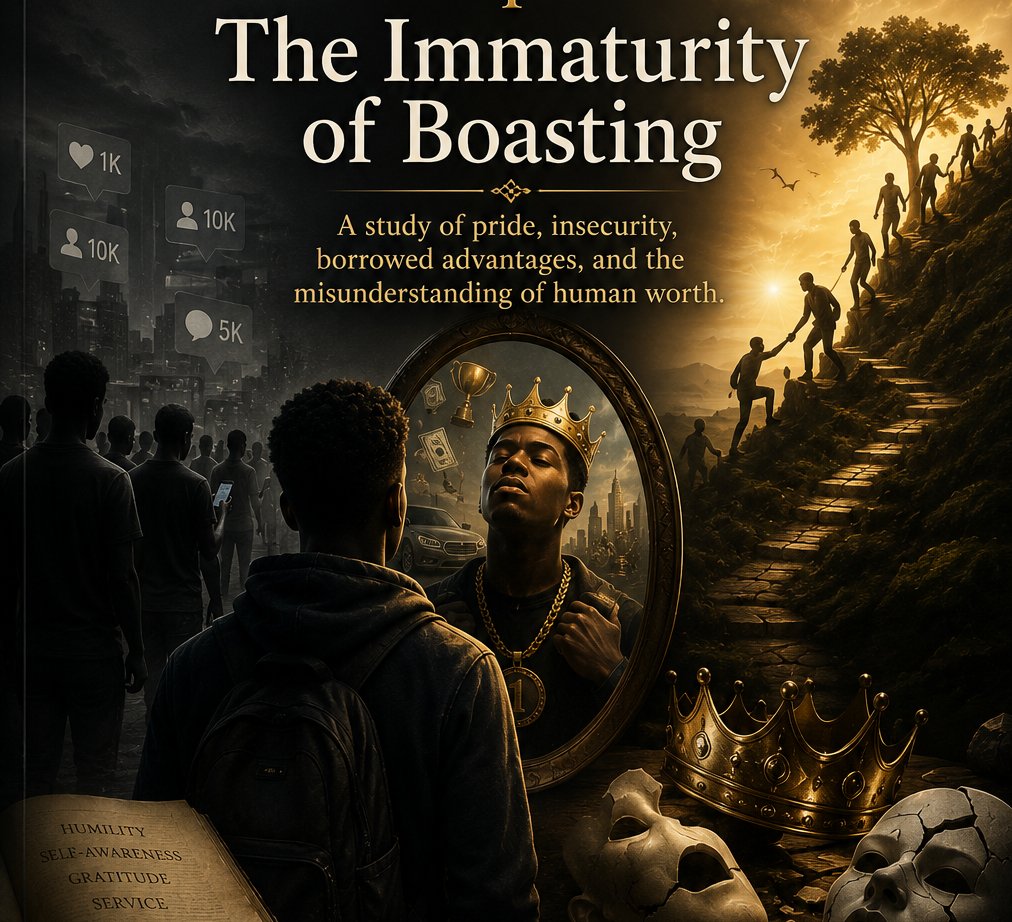
A study of pride, insecurity, borrowed advantages, and the misunderstanding of human worth.

Opening Thought
Many humans boast about things they did not fully create.
Beauty can be inherited.Strength can be inherited.Intelligence can be inherited.Opportunity can be accidental.
A person may become successful partly because:
- they were born in a safer place,
- met the right people,
- avoided sickness,
- received support,
- or survived conditions that destroyed others.
Yet many people behave as though success alone proves superiority.

This parchment studies boasting not only as bad behavior, but as a sign of incomplete thinking and emotional immaturity.
PART I : WHAT IS BOASTING?
Definition
Boasting is the intentional self-projection of superiority in value, status, intelligence, appearance, achievement, or power.
Boasting usually comes from:
- insecurity,
- comparison,
- attention seeking,
- fear of being ignored,
- competition,
- or misunderstanding human worth.

Not every display of success is boasting.
There is a difference between:
- confidence and arrogance,
- gratitude and superiority,
- sharing and self-worship.
PART II : SOME FORMS OF BOASTING
1. Wealth Boasting
Using money or expensive things to feel superior.
Examples:
- showing off unnecessarily,
- insulting poor people,
- believing money makes someone more human.
2. Intelligence Boasting
Using knowledge to make others feel small.
Examples:
- mocking people who learn slowly,
- always trying to appear smartest,
- speaking to dominate instead of help.
3. Beauty Boasting
Treating physical appearance as proof of importance.

Examples:
- obsession with admiration,
- disrespecting less attractive people,
- constant self-display.
4. Strength Boasting
Using physical power, toughness, or aggression to intimidate others.
5. Moral or Spiritual Boasting
Pretending to be morally superior.
Examples:
- doing good mainly for praise,
- looking down on imperfect people,
- turning morality into pride.
6. Group Boasting
Believing your tribe, school, country, religion, race, or social group automatically makes you superior.
7. Achievement Boasting
Constantly announcing achievements to gain validation.
8. Suffering Boasting
Using hardship as a competition.
Examples:
- “Nobody has suffered like me.”
- turning pain into superiority.
PART III : WHY HUMANS BOAST
1. Fear of Feeling Small
Many people fear being ordinary or unnoticed.
Boasting becomes a way to force importance.
2. Insecurity
People sometimes boast most about the things they fear losing.
A person insecure about intelligence may constantly try to appear intelligent.
A person insecure about wealth may constantly display money.
3. Social Pressure
Modern society rewards:
- attention,
- loudness,
- image,
- popularity,
- self-promotion.
Many people are trained to advertise themselves constantly.
4. Lack of Reflection
Many humans never deeply think about:
- luck,
- inherited advantages,
- invisible help,
- or how easily life could have gone differently.
5. Emotional Immaturity
Children naturally seek attention.
Some adults never outgrow this emotionally.
PART IV : BOASTING ACROSS AGE AND ENVIRONMENT
Teenagers
Teenagers often boast because they are:
- forming identity,
- seeking approval,
- competing socially,
- or trying to avoid rejection.
This is common, but maturity should gradually reduce it.
Adults
Adult boasting becomes more dangerous because adults influence:
- families,
- workplaces,
- leadership,
- and society.

Older Adults
Older people may boast about:

- experience,
- sacrifice,
- wisdom,
- or authority.
Age alone does not automatically create maturity.
Gender Trends
Both males and females boast, though often differently.
Males may boast more about:
- money,
- strength,
- status,
- dominance,
- achievements.
Females may boast more about:
- beauty,
- attention,
- social influence,
- relationships,
- lifestyle.
These are patterns, not absolute rules.
Environmental Influence
Humans raised in highly competitive environments often boast more.
Examples:
- celebrity culture,
- status-driven societies,
- social media environments,
- materialistic cultures.
PART V : WHY BOASTING IS ACTUALLY A JOKE

The Borrowed Capacity Problem
Most humans boast about borrowed things.
You did not create:
- your genetics,
- your brain structure,
- your birthplace,
- your appearance,
- your natural talents,
- your family background,
- your century,
- your early opportunities.
Even discipline itself is strongly affected by upbringing and environment.
This does not remove personal effort.It simply removes the illusion that humans are entirely self-created.
The Crossroad Reality
Every human stands near possible destruction.
A small change could alter everything:

- sickness,
- accident,
- poverty,
- emotional trauma,
- war,
- wrong friendships,
- bad guidance,
- bad timing.
A mature human understands:“I could have become very different under different conditions.”
Temporary Possessions
Beauty fades.Strength weakens.Money changes hands.Power changes.Popularity disappears.
Humans often boast over temporary conditions as though they are permanent.
Invisible Human Contributions
Even successful people depend on:
- farmers,
- builders,
- teachers,
- cleaners,
- engineers,
- inventors,
- road systems,
- electricity,
- countless unseen humans.
Absolute independence is mostly an illusion.
Boasting can produce:
Many boastful people emotionally collapse when admiration disappears.
PART VI : CONSEQUENCES OF BOASTING
Boasting does not only damage the individual.It also slowly damages society, relationships, learning culture, and younger generations.
When boasting becomes normal in a society, humans begin to value appearance more than substance, attention more than wisdom, and superiority more than contribution.
This creates unhealthy cultures.
1. Shallow Relationships
Boastful people often build relationships based on:
- status,
- admiration,
- usefulness,
- fear,
- or image.
Such relationships are usually weak.
People feel used, inferior, or emotionally unsafe around constant self-projection.
Real human connection becomes difficult when one person always needs to appear above others.

2. Inability to Learn
Boasting creates the illusion of already being complete.
Humans who constantly try to appear intelligent often become afraid of:
- correction,
- questions,
- failure,
- or admitting ignorance.
This weakens growth.
A person obsessed with appearing knowledgeable may stop truly learning.
3. Disrespect and Dehumanization
Boasting often encourages humans to disrespect people with:
- less money,
- less beauty,
- less education,
- lower social status,
- or fewer achievements.
This creates societies where human worth becomes tied to temporary advantages instead of humanity itself.
4. Emotional Blindness
Boastful people may become unable to see:
- other people’s struggles,
- invisible suffering,
- hidden disadvantages,
- or the role of luck and support in human success.
This weakens empathy.
Humans begin judging lives without understanding conditions.

5. Fragile Identity
Many boastful people build their identity around:
- beauty,
- popularity,
- money,
- power,
- achievements,
- or admiration.
But these things can disappear.
When admiration fades, some people emotionally collapse because they never built a stable internal identity.
6. Social Division
Boasting encourages unhealthy comparison.
Humans begin competing for:
- superiority,
- attention,
- validation,
- and dominance.
This can increase:
- envy,
- resentment,
- hostility,
- tribal thinking,
- and social tension.

A society obsessed with superiority slowly loses unity.

EFFECT ON YOUNGER GENERATIONS
Young people learn from what society rewards.
When youths constantly see humans praised for:
- display,
- arrogance,
- luxury,
- attention seeking,
- and superiority,
they may begin believing:
appearance is more important than character,and admiration is more important than usefulness.
This is dangerous for the future of humanity.
1. Attention Addiction
Many young people become emotionally dependent on:
- validation,
- praise,
- likes,
- popularity,
- and public attention.
Their self-worth becomes controlled by external reactions.
2. Reduced Depth of Thinking
Boasting cultures encourage performance over reflection.
Young people may spend more time:
- trying to appear successful,than actually becoming wise, useful, disciplined, or emotionally mature.
3. Fear of Failure
When society worships image, many youths become terrified of:
- embarrassment,
- imperfection,
- correction,
- or appearing ordinary.
This weakens courage and honest learning.
4. Increased Insecurity
Boasting creates endless comparison.
Young people constantly compare:
- appearance,
- wealth,
- lifestyle,
- intelligence,
- popularity,
- and achievement.
This can produce:
- anxiety,
- envy,
- depression,
- low self-worth,
- and emotional instability.
5. Weak Human Responsibility
A society focused only on self-display may produce humans who ask:
“How can I look important?”
instead of:
“How can I improve humanity?”
This weakens civilization itself.
Advanced societies cannot survive long if humans become emotionally immature, excessively self-centered, and addicted to superiority.
CLOSER OBSERVATION
Boasting may appear small,but when normalized across millions of people,it slowly shapes the culture of an entire civilization.
A society that rewards arrogance more than wisdom may eventually damage its own future.
True maturity teaches humans:

- to contribute more than they display,
- to understand more than they impress,
- and to value humanity more than superiority.
PART VII : SELF EXAMINATION
Reflection Questions
- Do I feel uncomfortable when ignored?
- Do I secretly enjoy appearing superior?
- Do I disrespect people with less status?
- Can I listen without trying to impress?
- What advantages did I inherit?
- How many of my successes depended on others?
- Would I survive under another person’s conditions?
- Who would I be without admiration?
Exercise : The Hidden Support List
Write down 25 things that helped your current life that you did not personally create.
Examples:
- language,
- transportation,
- parents,
- electricity,
- books,
- roads,
- internet,
- schools,
- medicine,
- other people’s labor.
This exercise weakens arrogance and increases realism.
PART VIII : HISTORY AND HUMAN REFLECTION
Throughout history, humans have boasted about:
- kingdoms,
- race,
- wealth,
- military power,
- intelligence,
- civilization,
- religion,
- beauty.
Many later collapsed.
History repeatedly shows that arrogance often appears before decline.
Wise humans study history and learn humility.
PART IX : WHAT TO DO INSTEAD
Replace boasting with:
- gratitude,
- usefulness,
- discipline,
- humility,
- service,
- deep learning,
- quiet confidence,
- and accurate self-understanding.
True maturity does not require self-worship.
Final Reflection
The mature human does not become smaller by abandoning boasting.
They become more truthful.
Wisdom begins when humans stop confusing temporary advantages with personal superiority.
Closing Question
If your advantages disappeared tomorrow,who would you still be?