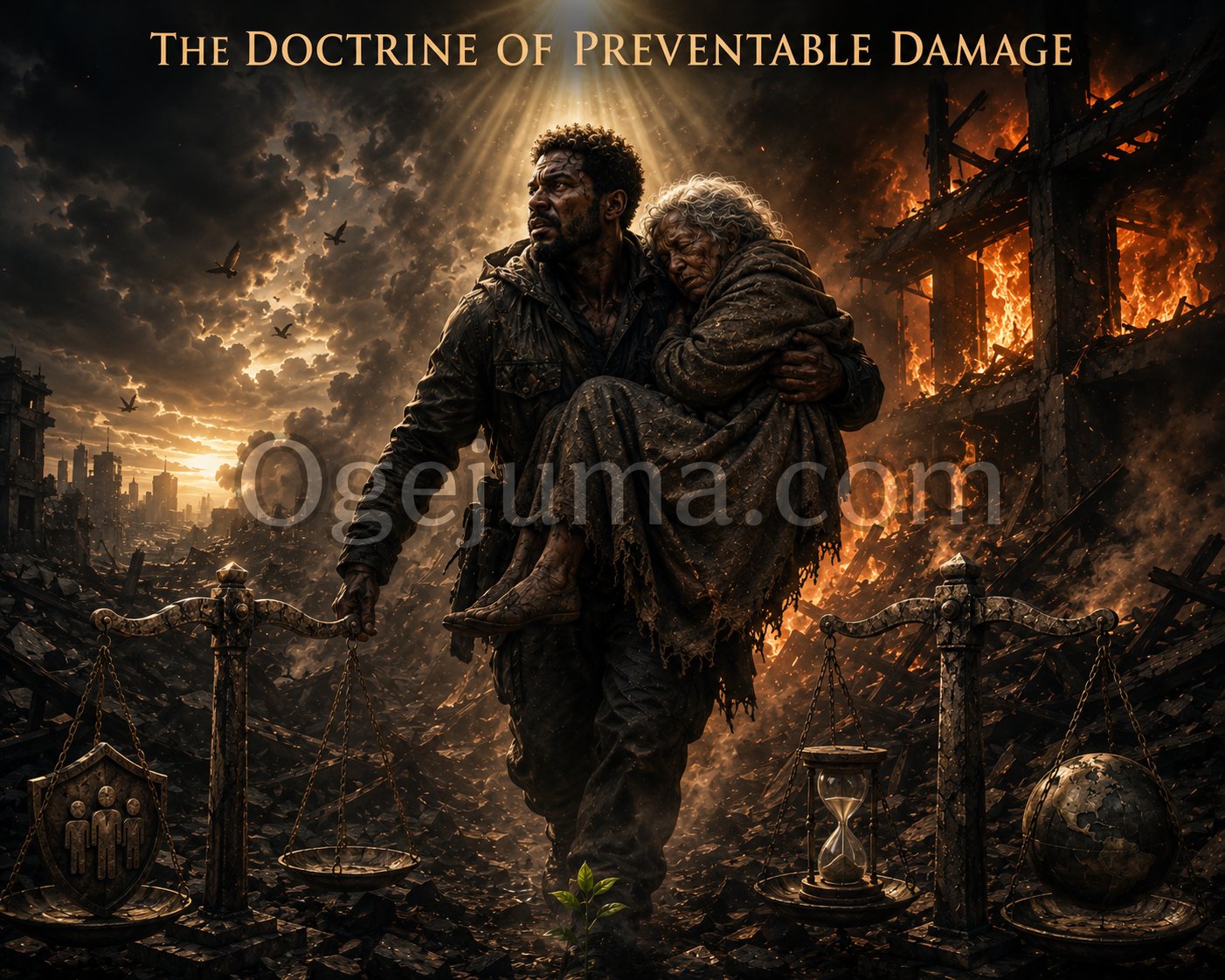
An Effort-Centered Framework for Responsibility, Civilization, and Human Continuity
Introduction
Human civilization has traditionally evaluated morality through two dominant approaches: intention and outcome. Some systems judge actions by whether intentions were pure, while others judge them by whether the resulting consequences produced more benefit than harm. Yet both approaches leave a critical gap unresolved:
What responsibility exists when harm could have been prevented through sufficient effort, but was not?
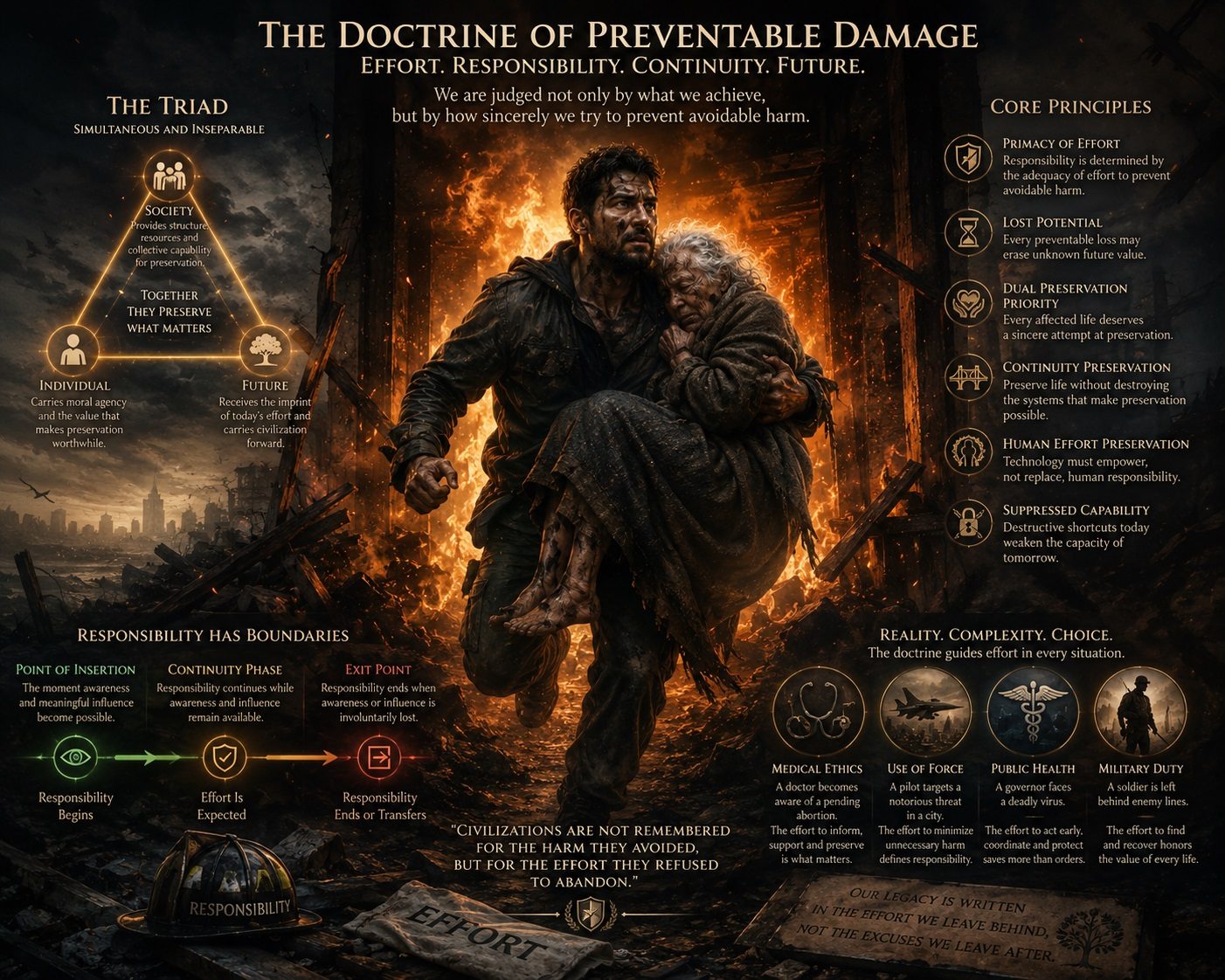
The Doctrine of Preventable Damage emerges from this gap. It proposes that the moral evaluation of individuals, institutions, and civilizations should not rest primarily on whether harm was entirely avoided, but on whether adequate, structured, and sincere effort was exerted to prevent avoidable damage once awareness and influence became possible.
The doctrine therefore shifts ethical focus away from absolute outcomes and toward the continuity of responsibility.
This framework is neither pacifist nor utopian. It accepts that:
- harm may occur,
- war may become necessary,
- difficult trade-offs may emerge,
- and success cannot always be guaranteed.
However, it rejects:
- negligence,
- arbitrary destruction,
- convenience-based shortcuts,
- abandonment of effort,
- and passive acceptance of preventable deterioration.
At its core, the doctrine argues:
Civilization is preserved not merely by successful outcomes, but by the seriousness with which humans attempt to prevent avoidable collapse, suffering, and loss.

The Triad Framework
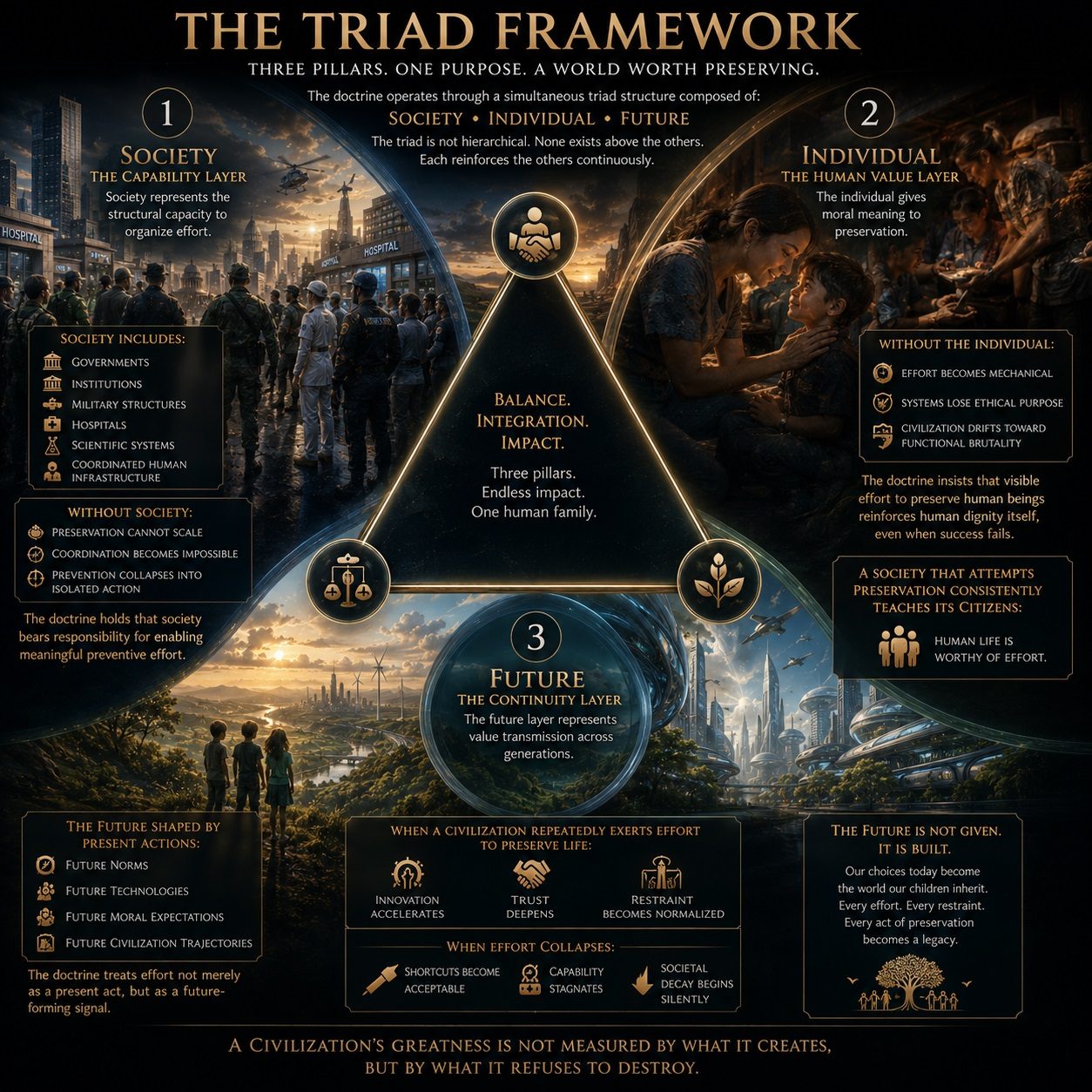
The doctrine operates through a simultaneous triad structure composed of:

- Society
- Individual
- Future
The triad is not hierarchical. None exists above the others. Each reinforces the others continuously.
1. Society - The Capability Layer
Society represents the structural capacity to organize effort.
Without society:
- preservation cannot scale,
- coordination becomes impossible,
- and prevention collapses into isolated action.
Society includes:
- governments,
- institutions,
- military structures,
- hospitals,
- scientific systems,
- and coordinated human infrastructure.
The doctrine therefore holds that society bears responsibility for enabling meaningful preventive effort.
2. Individual - The Human Value Layer
The individual gives moral meaning to preservation.

Without the individual:
- effort becomes mechanical,
- systems lose ethical purpose,
- and civilization drifts toward functional brutality.
The doctrine insists that visible effort to preserve human beings reinforces human dignity itself, even when success fails.
A society that attempts preservation consistently teaches its citizens:

Human life is worthy of effort.
3. Future — The Continuity Layer
The future layer represents value transmission across generations.
Every present action shapes:
- future norms,
- future technologies,
- future moral expectations,
- and future civilization trajectories.
The doctrine therefore treats effort not merely as a present act, but as a future-forming signal.
When a civilization repeatedly exerts effort to preserve life:
- innovation accelerates,
- trust deepens,
- and restraint becomes normalized.
When effort collapses:
- shortcuts become acceptable,
- capability stagnates,
- and societal decay begins silently.
Point of Insertion
One of the doctrine’s most critical concepts is the Point of Insertion.
Definition
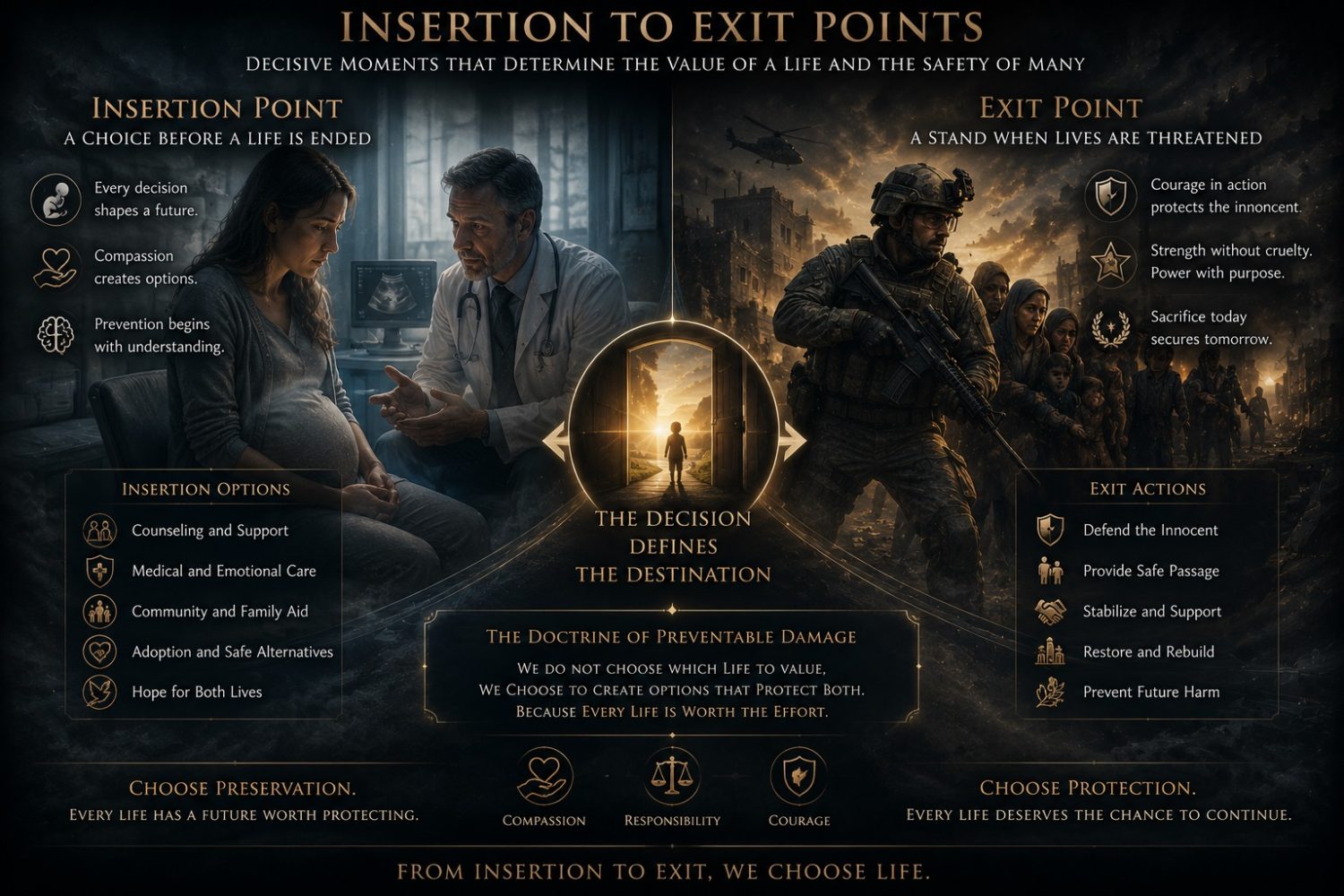
The Point of Insertion is the first moment an individual or system becomes aware of a situation and gains meaningful capacity to influence its outcome.
Before insertion:
- responsibility is inactive.
After insertion:
- effort becomes morally measurable.

This principle prevents unfair responsibility assignment while also defining the exact activation point of obligation.
Exit Point
The doctrine also recognizes that responsibility cannot remain infinite.
Definition
The Exit Point is the moment an entity involuntarily loses meaningful awareness, continuity access, or influence over a situation.
Once legitimate exit occurs:
- active responsibility ends,
- or transfers elsewhere.
This prevents unrealistic perpetual accountability.
Scenario I - The Pending Abortion
A woman has already initiated abortion procedures before a doctor becomes aware of the case.
The doctor now reaches the Point of Insertion.
At this moment:
- awareness exists,
- influence becomes possible,
- responsibility activates.
The doctrine does not evaluate the situation merely by whether the pregnancy ultimately continues or terminates. Instead, it evaluates:
what effort was exerted once insertion occurred.
The doctor may:
- explain alternatives,
- discuss medical support,
- suggest adoption pathways,
- involve counselors,
- or explore emerging preservation technologies.
A pharmacist who becomes aware of the situation may also reach insertion if meaningful influence exists.
The mother herself remains part of the triad:
- as an individual with dignity,
- within a societal structure,
- while simultaneously affecting future value transmission.
Severe Illness Scenario
Suppose the mother suffers from severe illness.
The doctrine does not demand reckless preservation at all costs. Instead, it asks:
- Was serious effort made to preserve both lives?
- Were all realistic preservation pathways explored?
- Was action guided by structured responsibility rather than convenience?
Even where loss becomes unavoidable, visible preservation effort still matters because:
- it reinforces future medical advancement,
- pressures society toward innovation,
- and strengthens the value assigned to vulnerable life.
The doctrine therefore prioritizes:
- preservation effort,
- not simplistic outcome absolutism.
Scenario II - The Air Force Pilot
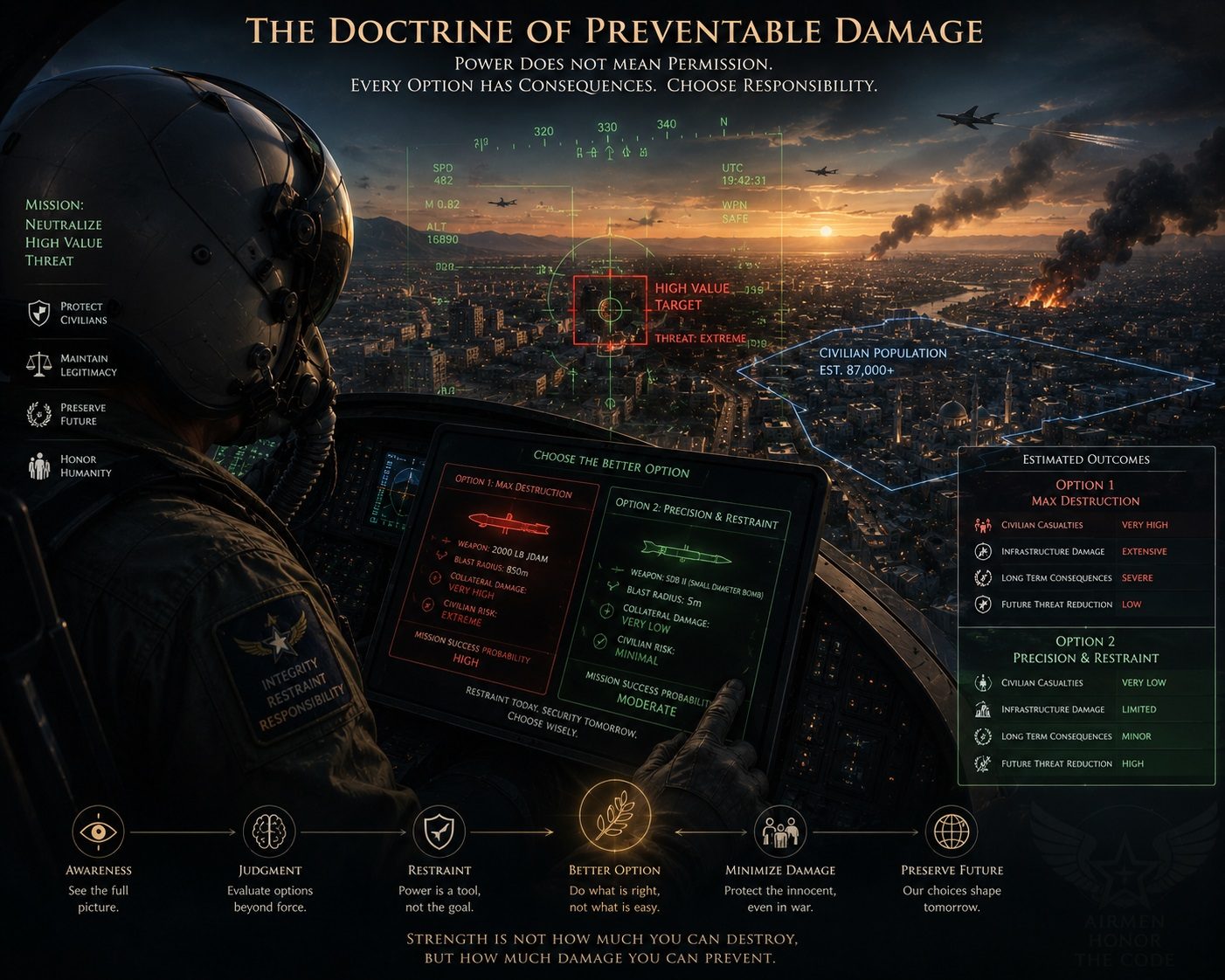
An air force pilot hovers above a city containing civilians and a notorious bandit leader responsible for mass violence.
The pilot possesses overwhelming destructive capability.
Traditional systems may ask:

Should the target simply be eliminated?
The doctrine asks differently:
What effort is being made to prevent unnecessary damage within the exercise of force?
The pilot therefore enters a triad evaluation:
Society Layer
- protection of civilians,
- security stabilization,
- maintenance of order.
Individual Layer
- recognition that civilians retain value even within hostile space.
Future Layer
- preservation of military restraint norms,
- reinforcement of disciplined force application.
The doctrine does not forbid offensive action. Rather, it evaluates whether:
- targeting was structured,
- alternatives were explored,
- civilian preservation effort existed,
- and destruction remained disciplined relative to capability.
Thus:
restraint is measured relative to available power, not by the total absence of force.
Scenario III - A Governor and a Viral Outbreak
A governor becomes aware of a rapidly spreading virus.
This awareness creates the Point of Insertion.
Responsibility activates immediately.
The doctrine now evaluates:
- speed of organized response,
- transparency,
- mobilization effort,
- scientific engagement,
- healthcare coordination,
- and preventive communication.

Even if casualties eventually occur, the doctrine asks:
Was sufficient effort exerted once awareness and influence became possible?
A governor who:
- hides information,
- delays response,
- suppresses warnings,
- or avoids mobilization
violates the doctrine through negligence of effort.
Conversely, even an imperfect response may align with the doctrine if:
- effort was structured,
- capability was mobilized,
- and preservation was sincerely pursued.
Scenario IV - The Soldier Behind Enemy Lines
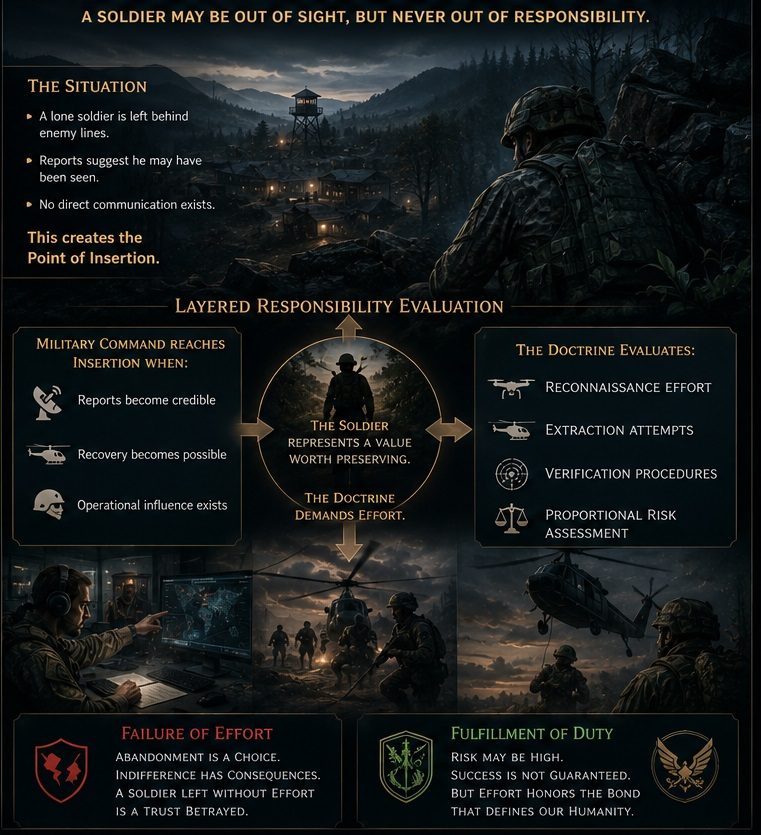
A lone soldier is left behind behind enemy lines.
Reports emerge suggesting he may have been seen, but no direct communication exists.
The doctrine now activates a layered responsibility evaluation.
Military Command
Military command reaches insertion when:
- reports become credible,
- recovery becomes possible,
- and operational influence exists.
The doctrine evaluates:
- reconnaissance effort,
- extraction attempts,
- verification procedures,
- and proportional risk assessment.
The Importance of Effort
The doctrine does not necessarily require catastrophic sacrifice to retrieve the soldier.
However, it strongly rejects:
- arbitrary abandonment,
- premature disengagement,
- or convenience-based dismissal.
Why?

Because visible effort creates future value transmission.
An army that consistently demonstrates:
“No one is casually abandoned”
generates:
- loyalty,
- trust,
- institutional cohesion,
- and stronger future commitment.
Thus, even incomplete rescue attempts may reinforce civilization-level values.
The Doctrine and War
The doctrine does not prohibit war.
Instead, it disciplines power.
A nation may:
- defend itself,
- strike offensively,
- or deploy overwhelming capability.
However, it remains accountable for:
- the structure of its effort,
- the restraint within its power,
- and the seriousness with which unnecessary damage was prevented.
Thus:
- random destruction violates the doctrine,
- careless escalation violates the doctrine,
- vengeance-driven violence violates the doctrine.
But:
- organized force with disciplined preservation effort may align with it.
Corruption and Silent Collapse
The doctrine views corruption as:
suppression of societal effort capacity.
Corruption diverts:
- resources,
- trust,
- coordination,
- and preservation capability
away from collective continuity.
The danger of corruption is not merely unfairness.
Its deeper danger is:
long-term erosion of civilization’s ability to exert meaningful preventive effort.

Artificial Intelligence and Human Responsibility
The doctrine also addresses AI governance.
It warns against systems that:
- eliminate meaningful human responsibility,
- replace moral judgment entirely,
- or reduce humans to passive recipients of automated decisions.
The doctrine therefore insists:
technology must augment human capability, not erase human moral participation.
Human effort remains central to:
- responsibility,
- value transmission,
- and civilization continuity.
Doctrine of Perpetual Critique
The Doctrine of Preventable Damage intentionally rejects claims of perfection.
Instead, it contains within itself the requirement for future criticism and refinement.
Its unresolved tensions are not viewed as failures, but as:
signals for future intellectual advancement.
This protects the doctrine from:
- rigidity,
- ideological stagnation,
- and intellectual corruption.
Conclusion
The Doctrine of Preventable Damage proposes a civilization-centered ethical framework grounded not primarily in outcomes, but in the continuity and seriousness of preventive effort.
It argues that:
- responsibility begins at awareness,
- effort becomes measurable through influence,
- and civilizations are ultimately shaped by the consistency with which they attempt to prevent avoidable damage.
The doctrine therefore asks humanity a different question.
Not:
“Did harm disappear?”
But:
“Once responsibility became possible, did we truly try?”