A Civilizational Lens for Understanding Human Participation
Introduction
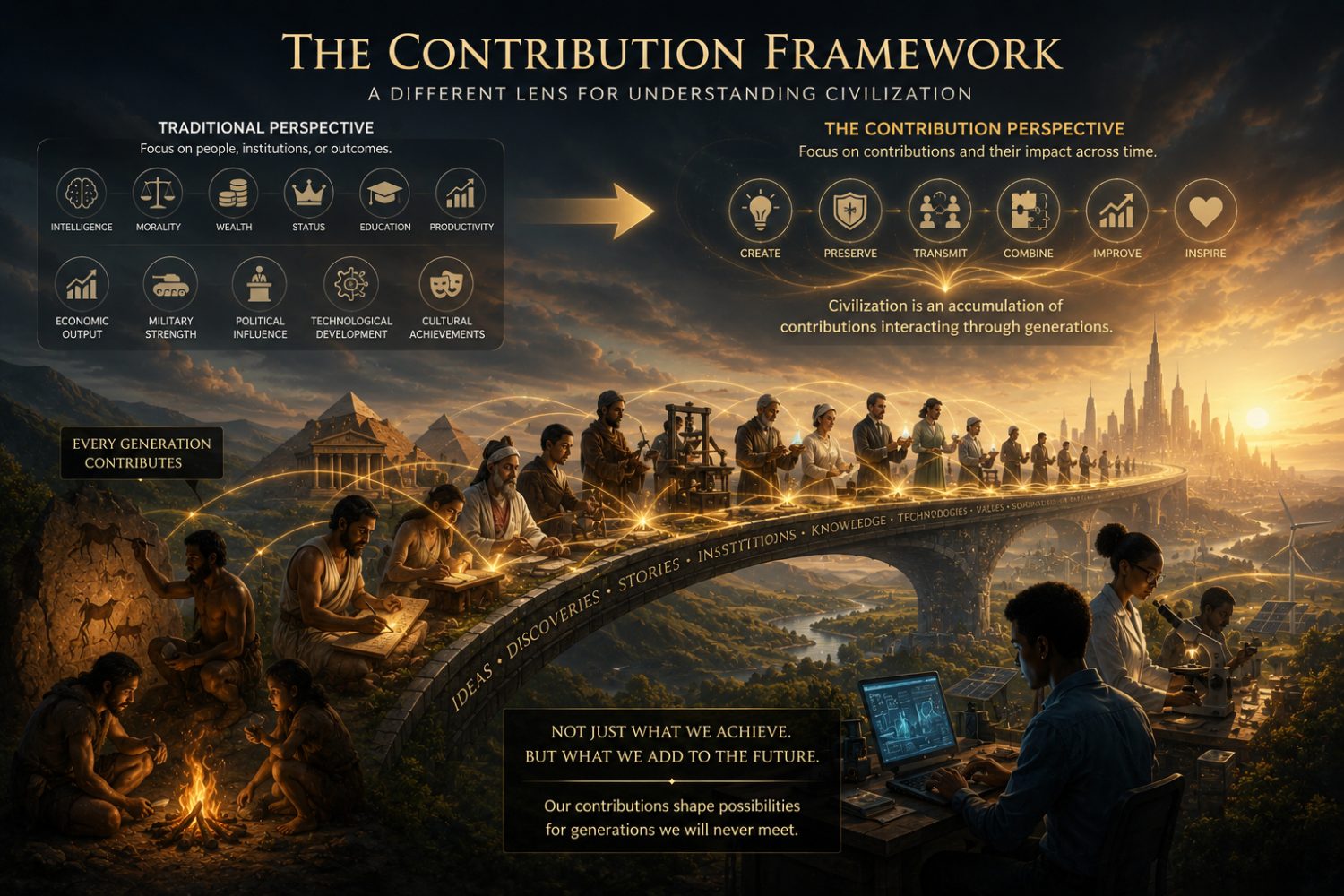
Most frameworks evaluate individuals through characteristics such as intelligence, morality, wealth, status, education, or productivity. Civilizations are similarly evaluated through economic output, military strength, political influence, technological development, or cultural achievements.
The Contribution Framework proposes a different perspective.
Rather than focusing primarily on people, institutions, or outcomes, it focuses on contributions and the role they play in shaping civilization across time.
Under this framework, civilization can be understood as an accumulation of contributions interacting through generations.
Contribution Is Unavoidable
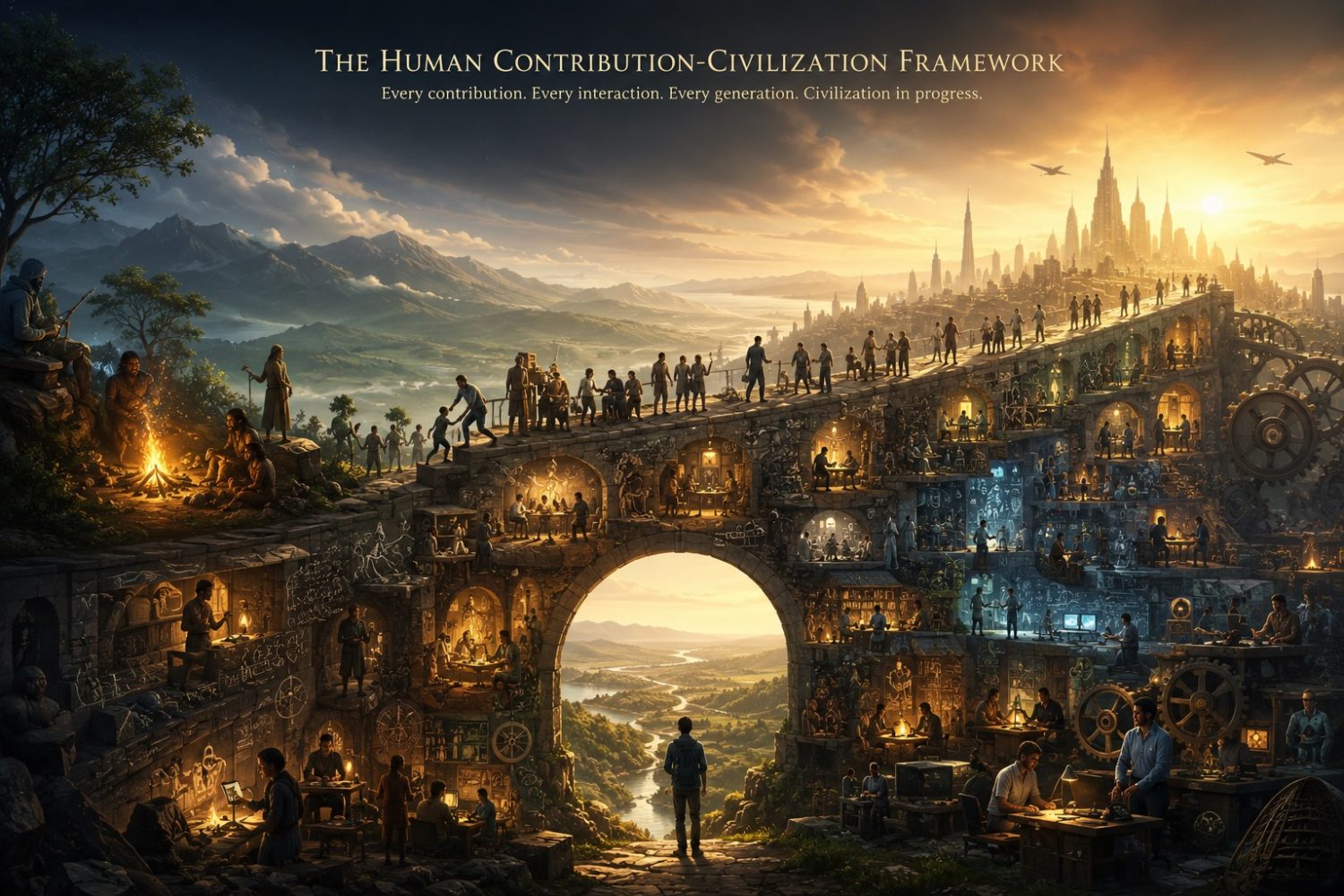
Contribution is often treated as a deliberate act of service, creativity, or sacrifice. The Contribution Framework adopts a broader definition.
Human beings contribute simply by existing within a system.
Every action changes future conditions.

Every decision influences outcomes.
Every interaction produces effects.
Even inaction can alter future events.
Contribution is therefore not optional. The question is not whether individuals contribute, but how they contribute and what effects emerge from their participation.
Civilization as an Accumulation of Contributions
Civilization can be viewed as a large-scale system for storing, preserving, transmitting, combining, and generating contributions.
Languages preserve contributions.
Institutions preserve contributions.
Scientific knowledge preserves contributions.
Technologies preserve contributions.
Cultural practices preserve contributions.
Each generation inherits a vast inventory of contributions created by previous generations and adds to, modifies, or diminishes that inventory before passing it forward.
From this perspective, civilization is not merely a collection of people. It is a continuous process of contribution accumulation.
The Problem of Time
Human beings possess finite lifespans.

Civilizations do not.
One of civilization's most remarkable characteristics is its ability to allow contributions to survive beyond the lives of contributors.
A scientific discovery may influence events centuries after its creator has died.
A useful idea may outlive entire nations.
A contribution can therefore be viewed as one of the mechanisms through which human influence extends beyond individual existence.
Civilization functions partly as a solution to the problem of time.

Progress Without a Destination
Humanity often behaves as though progress is desirable, yet history suggests that people rarely know in advance what future capabilities they will value.
Few people anticipated automobiles before their existence.
Few anticipated antibiotics, computers, or the internet.
Yet once these capabilities appeared, societies reorganized around them.
This suggests that human progress is not primarily the pursuit of a known destination.
Instead, it is a process of discovering new capabilities and integrating them into civilization.
Contribution is the mechanism through which these capabilities emerge.
Contribution and Capability Expansion
If humanity continuously adopts useful new capabilities, then contributions become important because they increase the probability that new capabilities will emerge.
Contribution is not necessarily valuable because it is morally good.
Contribution is valuable because it expands the range of possibilities available to civilization.
The relationship between contribution and progress is therefore structural rather than moral.
The Contribution Spectrum
Because contribution is unavoidable, individuals differ primarily in the patterns through which they affect civilization.
The Contribution Spectrum describes these patterns.
Generators
Generators create new contributions.
They introduce ideas, methods, knowledge, solutions, or possibilities that did not previously exist.
Their defining activity is creation.
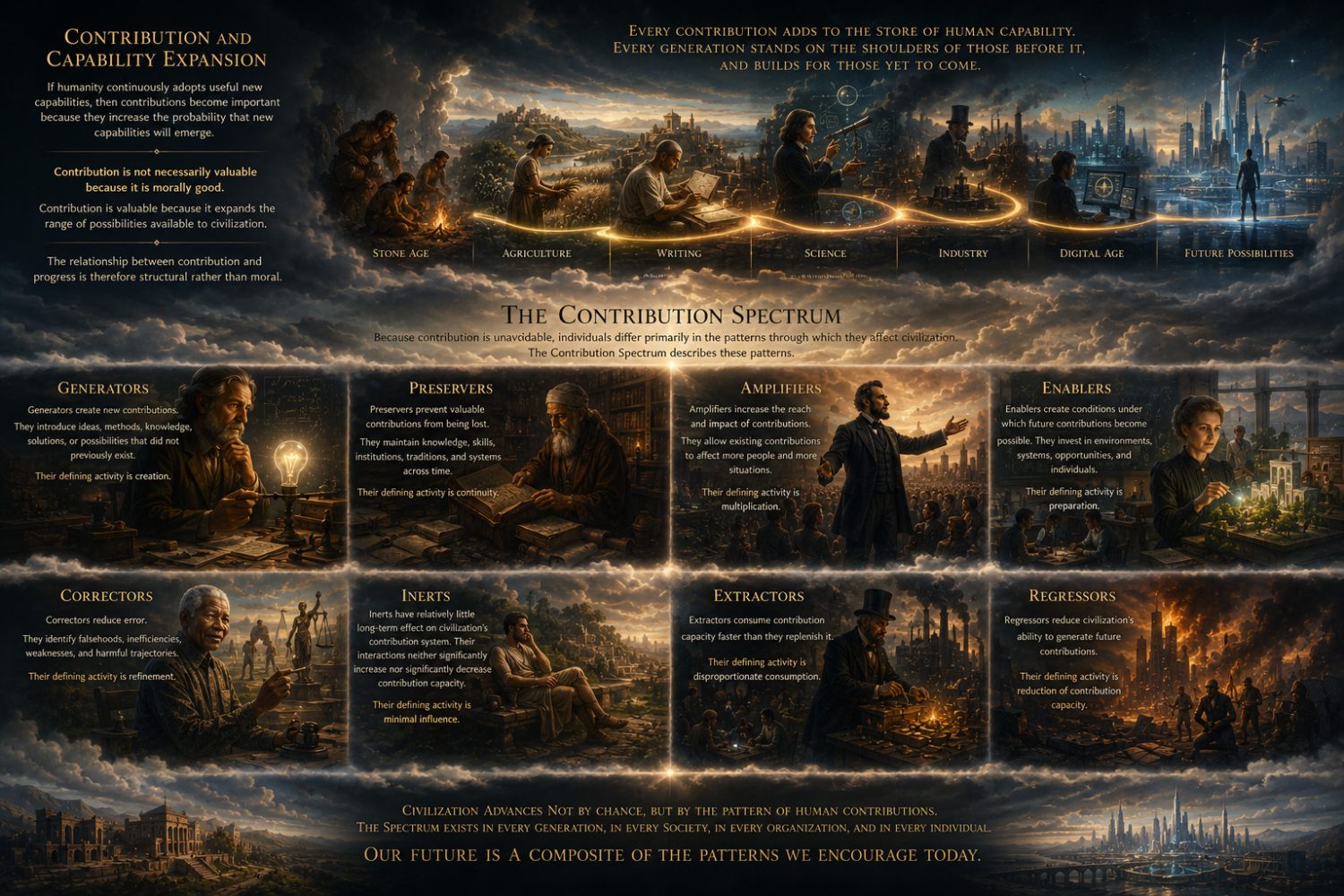
Preservers
Preservers prevent valuable contributions from being lost.
They maintain knowledge, skills, institutions, traditions, and systems across time.
Their defining activity is continuity.
Amplifiers
Amplifiers increase the reach and impact of contributions.
They allow existing contributions to affect more people and more situations.
Their defining activity is multiplication.
Enablers
Enablers create conditions under which future contributions become possible.
They invest in environments, systems, opportunities, and individuals.
Their defining activity is preparation.
Correctors
Correctors reduce error.
They identify falsehoods, inefficiencies, weaknesses, and harmful trajectories.
Their defining activity is refinement.

Inerts
Inerts have relatively little long-term effect on civilization's contribution system.

Their interactions neither significantly increase nor significantly decrease contribution capacity.
Their defining activity is minimal influence.
Extractors
Extractors consume contribution capacity faster than they replenish it.
Their defining activity is disproportionate consumption.

Regressors
Regressors reduce civilization's ability to generate future contributions.
Their defining activity is reduction of contribution capacity.
The Nature of Inertness
Not all inertness is identical.
Temporary Inertness
Periods of rest, recovery, learning, and reflection may appear inactive while supporting future contribution.

Suppressed Inertness
Contribution remains low because opportunities are absent.
The limitation is environmental rather than personal.
Dormant Inertness
Contribution remains low despite substantial potential and tendency.
The contributor exists but has not yet been activated.
Contribution Tendency
Observed contribution is not always a reliable indicator of future contribution.
Some individuals consistently display behaviors associated with contribution even when their outputs remain limited.
Contribution Tendency attempts to measure the likelihood that an individual will contribute under suitable conditions.
It focuses on direction rather than achievement.
Indicators of Contribution Tendency
Contribution Tendency may be reflected through curiosity, agency, persistence, constructiveness, learning behavior, problem sensitivity, and cooperative ability.
These traits do not guarantee contribution, but they increase its probability.
The Contribution Potential Index
Contribution Potential Index (CPI) estimates unrealized contribution capacity.
It attempts to answer a different question from conventional measurements.
Rather than asking what a person has contributed, CPI asks what contribution could reasonably emerge under appropriate conditions.
A person may possess high potential while displaying low observable output.
Capacity
The capabilities available to the individual.
Tendency
The likelihood of contribution behavior emerging.
Opportunity
The environmental conditions that allow contribution to occur.
CPI Relationship
Contribution Potential can be understood as the interaction between capacity, tendency, and opportunity.
A deficiency in any one component can reduce realized contribution.
Dormant Contributors
Every civilization contains individuals whose contribution potential exceeds their realized contribution.
These individuals represent dormant contributors.
Some lack resources.
Some lack education.
Some lack opportunities.
Some lack activation.
The existence of dormant contributors suggests that one of civilization's greatest losses may be unrealized contribution rather than failed contribution.
The Contribution Gap
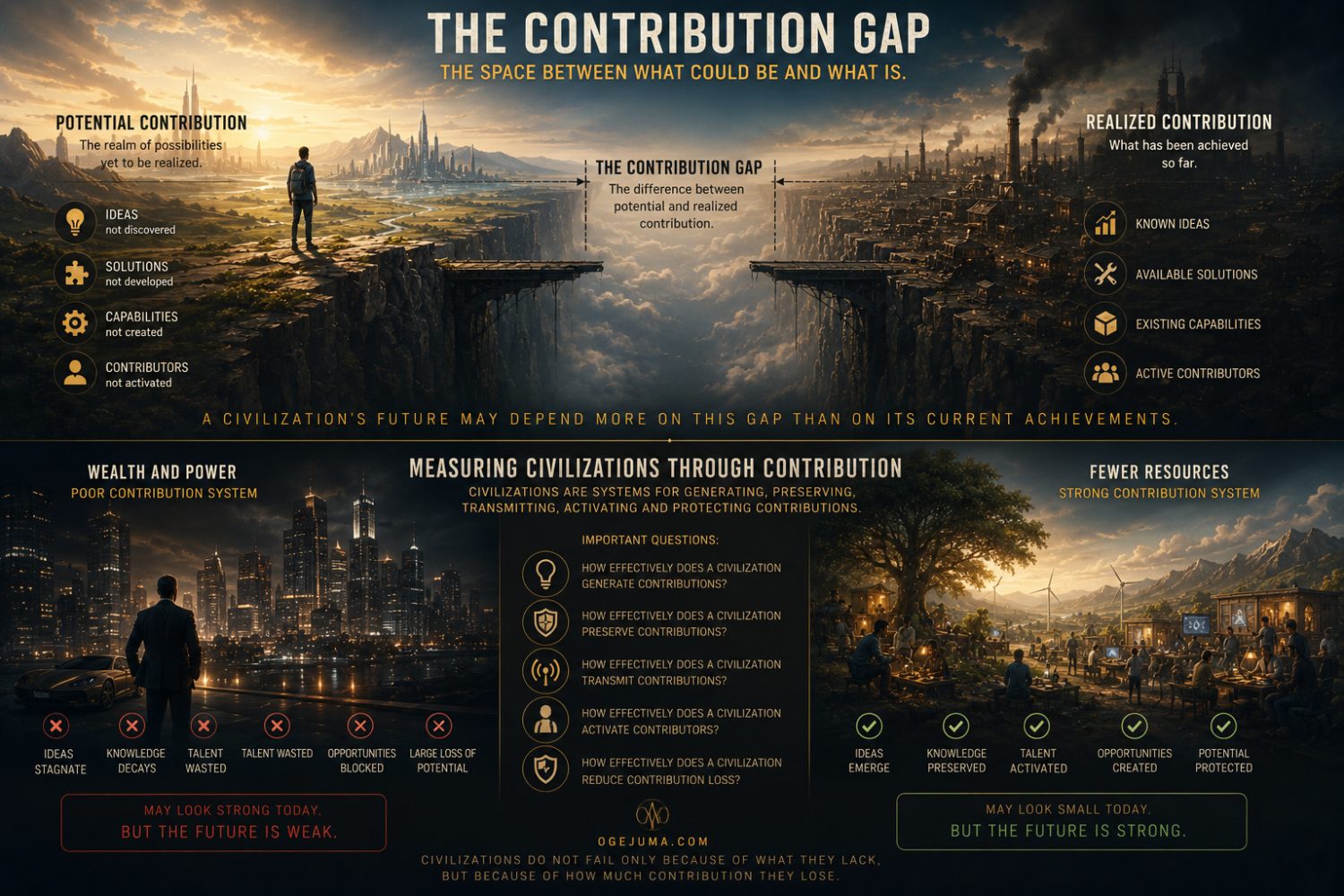
Every civilization possesses a difference between potential contribution and realized contribution.
This difference can be called the Contribution Gap.
The Contribution Gap represents:
- Ideas not discovered.
- Solutions not developed.
- Capabilities not created.
- Contributors not activated.
A civilization's future may depend more on this gap than on its current achievements.
Measuring Civilizations Through Contribution
Civilizations can be evaluated according to their effectiveness as contribution systems.
Important questions include:
How effectively does a civilization generate contributions?
How effectively does it preserve contributions?
How effectively does it transmit contributions?
How effectively does it activate contributors?
How effectively does it reduce contribution loss?
A civilization may possess wealth and power while performing poorly in these areas.
Another may possess fewer resources while generating exceptional contribution capacity.
The Contribution Civilization
A contribution-oriented civilization would focus not only on outcomes but on contribution generation itself.
Its institutions would seek to identify dormant contributors.
Its systems would seek to reduce barriers to contribution.
Its culture would encourage contribution awareness.
Its measurements would extend beyond output toward potential.
The objective would not be maximizing productivity alone.

It would be maximizing civilization's capacity to generate valuable future contributions.
Conclusion
Human beings cannot avoid contributing.

Every action, decision, interaction, and omission alters the future state of civilization.
Contribution is therefore not a specialized activity performed by a minority of people.
It is a universal consequence of participation.
Civilization itself can be understood as the accumulation of these contributions across time.
Under the Contribution Framework, the central challenge of humanity becomes clearer.
The question is not whether contributions exist.
The question is how effectively civilization can understand, preserve, direct, activate, and expand them.