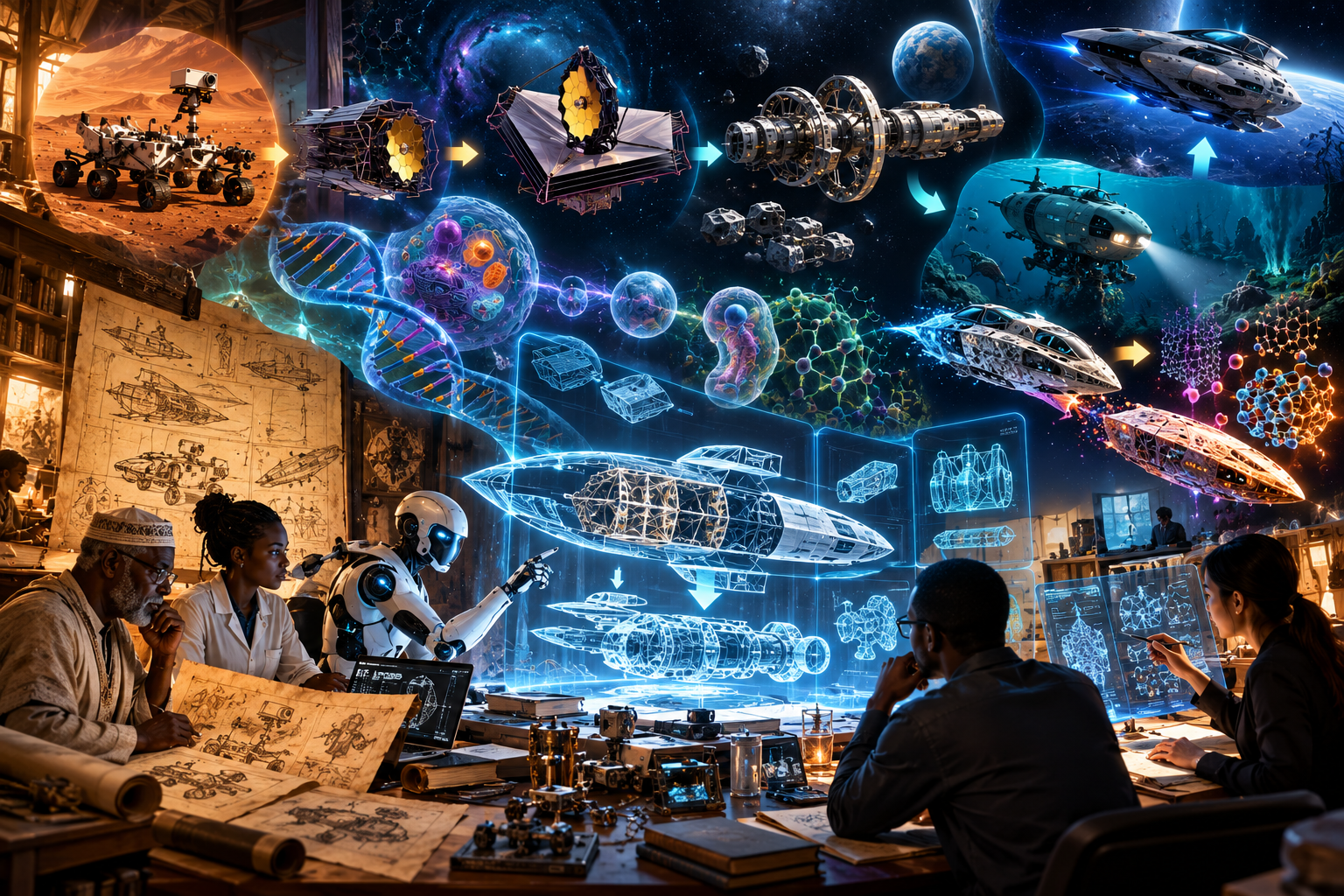
A Framework for Systems Designed to Transform Beyond Their Original Form
Most things we design are expected to remain relatively stable after they are created.
A chair remains a chair. A car remains a car. A building remains a building.
Their parts may move, but the basic material structure is established at the beginning.
Morphologically Disruptable Design begins with a different question:
What if a system is deliberately designed to change its own physical form during its existence?
Here, morphology refers to the physical form, structure, and arrangement of a system. A morphological change therefore occurs when the system moves from one physical configuration to another.
The important point is that the change must not simply happen by accident. The capacity for the transformation must be part of the original design.
The Origin-Intent Principle
A system should not be classified according to everything it might eventually do.
The classification concerns what was intentionally incorporated into the system when it was designed.
For example, if a machine accidentally changes shape because a component breaks, that does not make it a transformational design.
Similarly, if a system later acquires a new capability through modification that was not part of its original design, that capability does not automatically change its original design level.
The central principle is:
The destination does not have to exist at the origin; the intentional capacity to reach the destination must exist there.
This means a system can be designed today to become something physically different tomorrow.
The Four Levels of Material Design
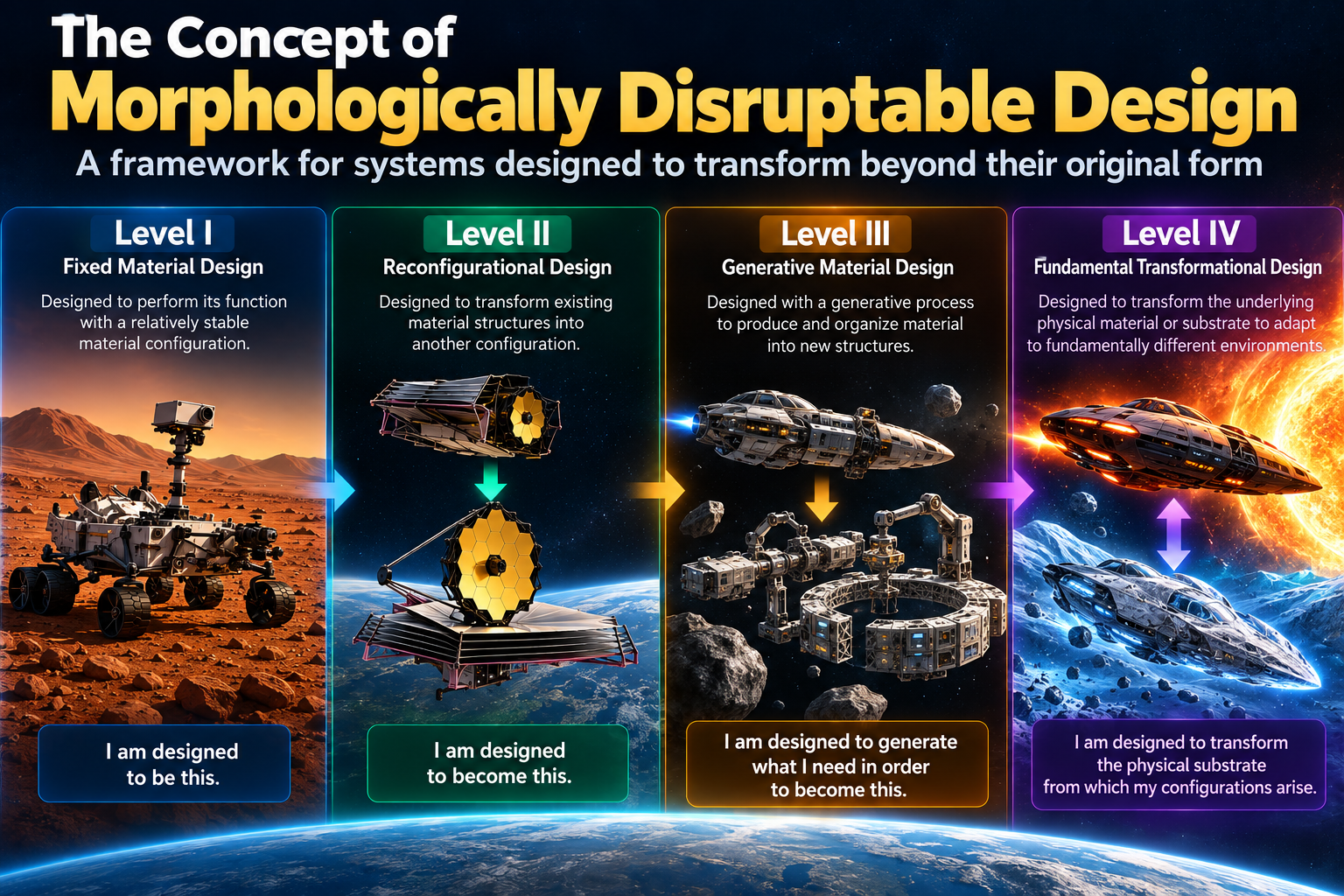
Morphologically Disruptable Design can be considered in four levels.
Level I — Fixed Material Design
At Level I, the system is designed to perform its function with a relatively stable material configuration.
Its basic statement is:
“I am designed to be this.”
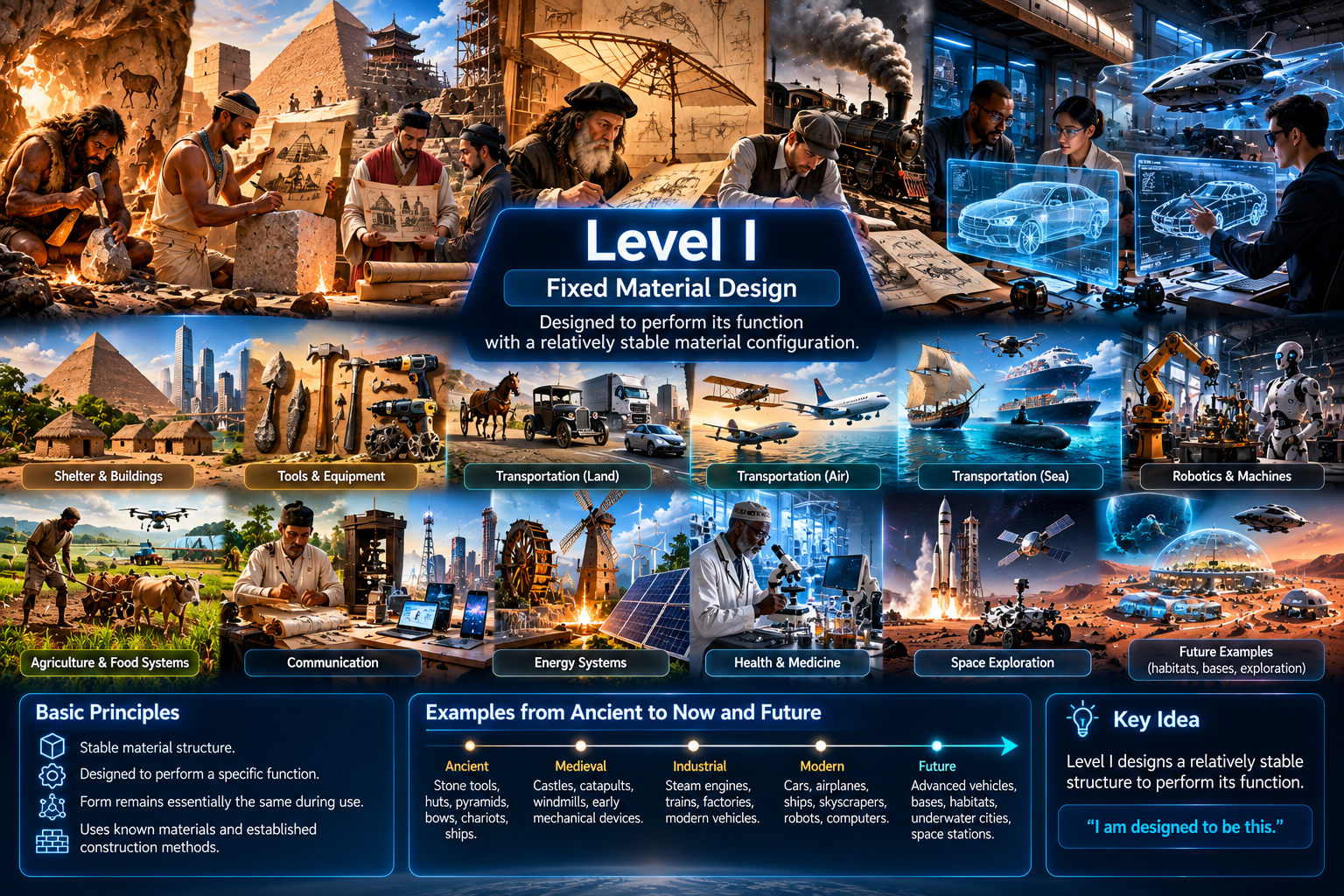
Consider a planetary rover.
The rover may have wheels that rotate, cameras that move and robotic arms that operate. These movements are necessary for its function, but the rover is not designed to become a substantially different physical system.

Its morphology remains relatively stable.
Key principle:
The structure is designed to perform the function.
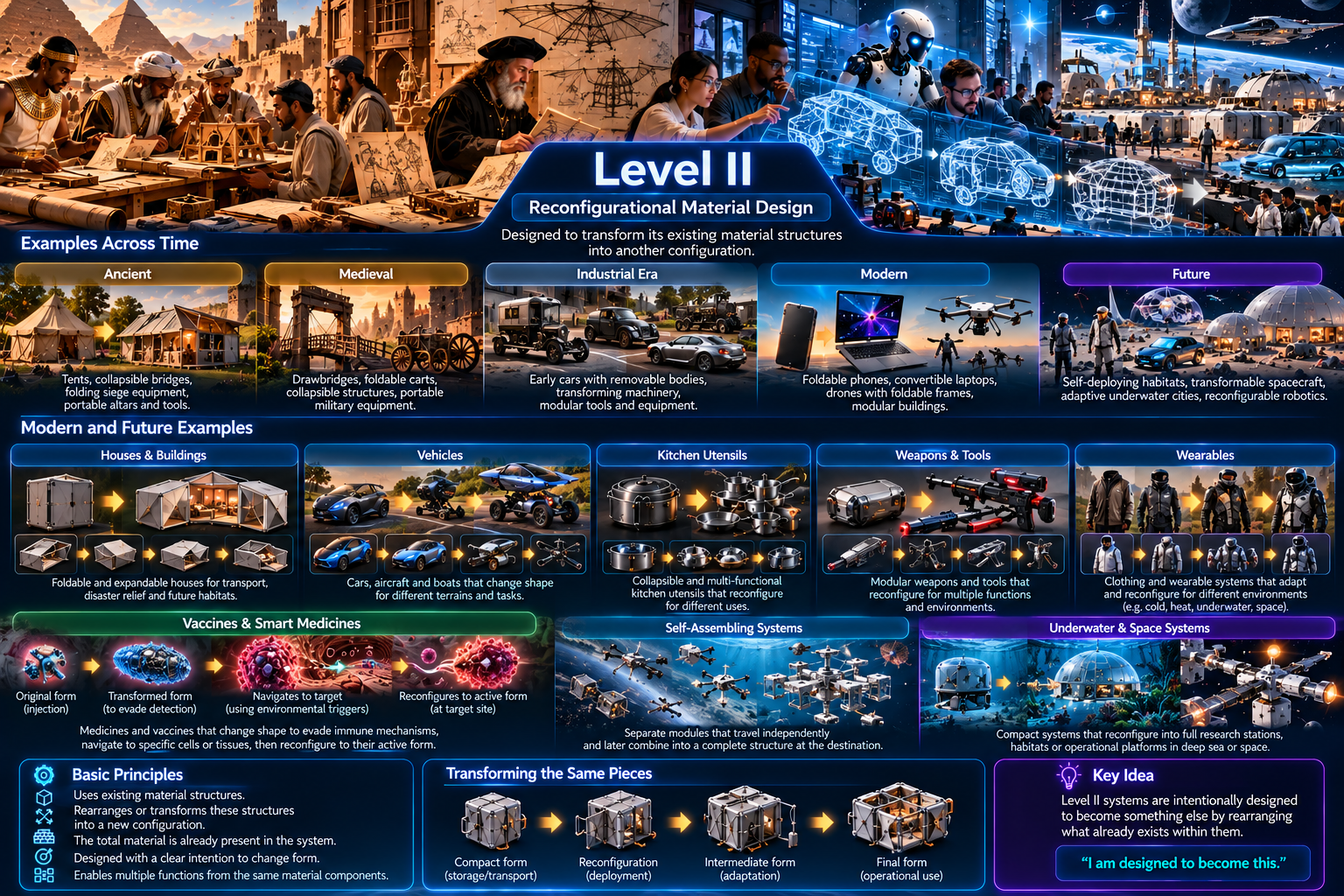
Level II — Reconfigurational Material Design
Level II introduces intentional morphological transformation.
The system is designed to rearrange material structures that already exist within it in order to become another configuration.
Its basic statement is:
“I am designed to become this.”
A good real-world example is the James Webb Space Telescope.
JWST was launched in a compact configuration. After reaching space, its mirrors, sunshield and other structures underwent a carefully designed sequence of deployments.
Its operational configuration was therefore different from its launch configuration.
But the telescope did not manufacture those structures after launch. The structures already existed.
The system rearranged and deployed existing material structures.
That makes JWST a Level II example.
Key principle:
Level II transforms existing material structures into a new morphology.
Level III — Generative Material Design
Level III represents a deeper form of transformation.
Here, the system does not merely rearrange structures that already exist.
It contains a generative process or program capable of producing and organizing material into structures that were not present as such at the beginning.
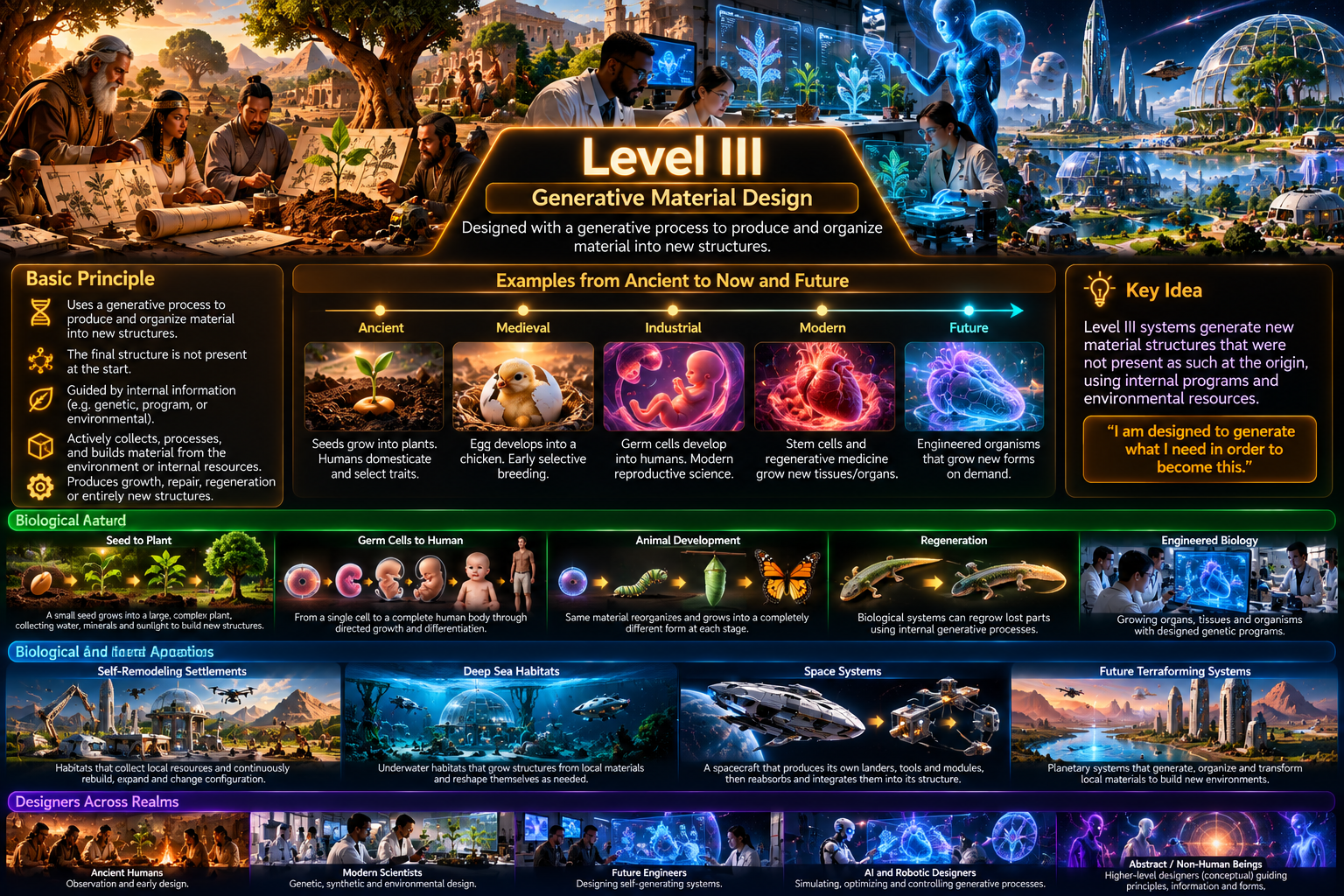
Its basic statement is:
“I am designed to generate what I need in order to become this.”
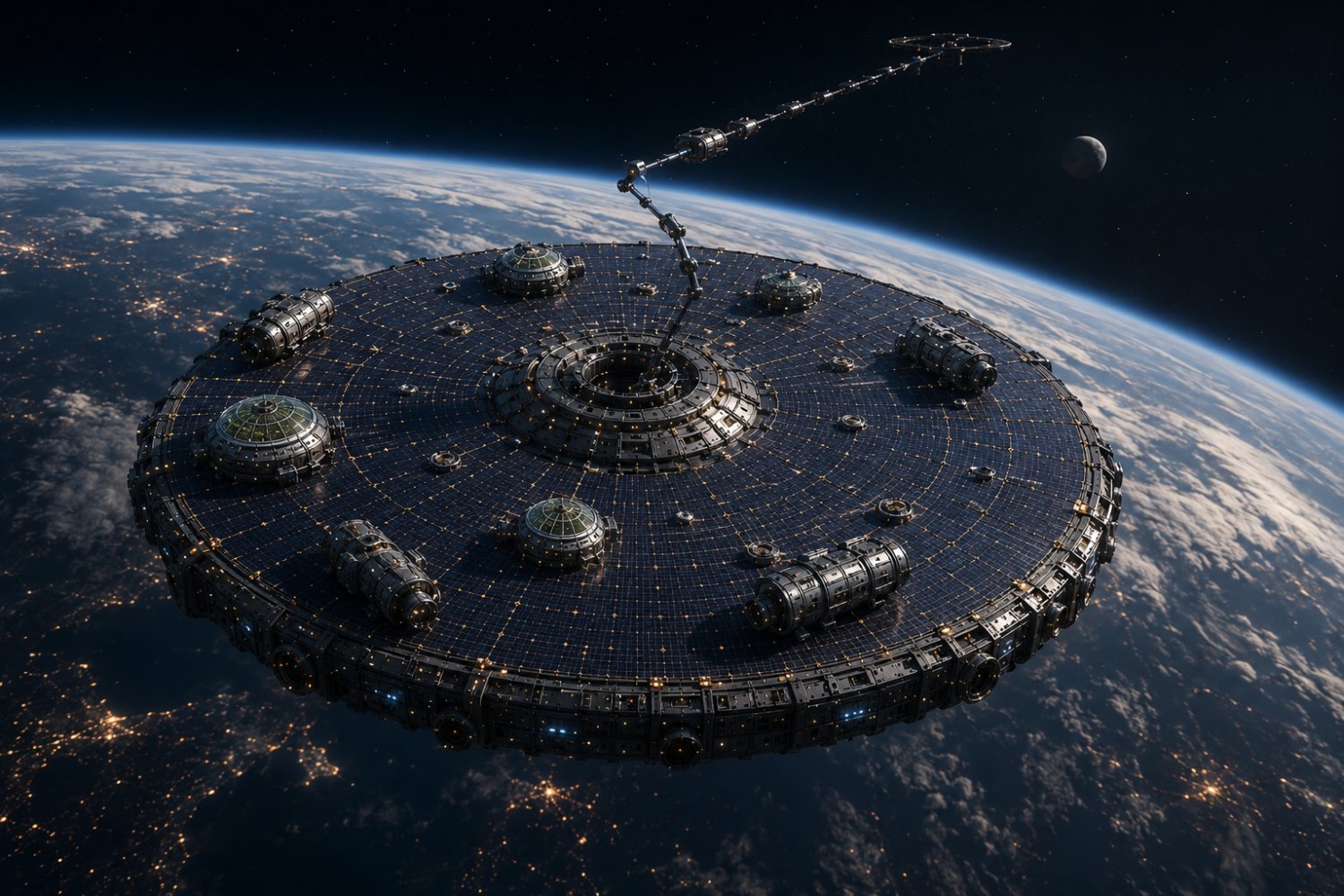
Imagine a future spacecraft that begins its journey as a relatively compact vehicle.
When it reaches a particular environment, it could:
- collect suitable raw material,
- process the material,
- generate components,
- assemble those components,
- form a new operational structure,
- later dismantle or transform that structure when it is no longer needed.
The new structure was not simply stored inside the spacecraft.
The spacecraft was designed with the capacity to generate it.
if you encounter a type III design you are unlikely to know what is future morphology will look like.
That is the essential difference between Level II and Level III.
A biological example
Biological systems provide a useful way to understand this principle.
Genetic information can act as a generative program through which molecular processes produce and organize material into structures.
In simplified form:
Genetic information → material production → organization → morphology
The final cellular structures are not simply sitting in the original genetic material as miniature physical structures. They emerge through a process of material generation and organization.
This demonstrates an important feature of Level III:
The design can exist as information or a generative process while the resulting material morphology is produced later.
Therefore, Level III should not be defined merely as “a machine that manufactures things.”
The deeper principle is generative material design.
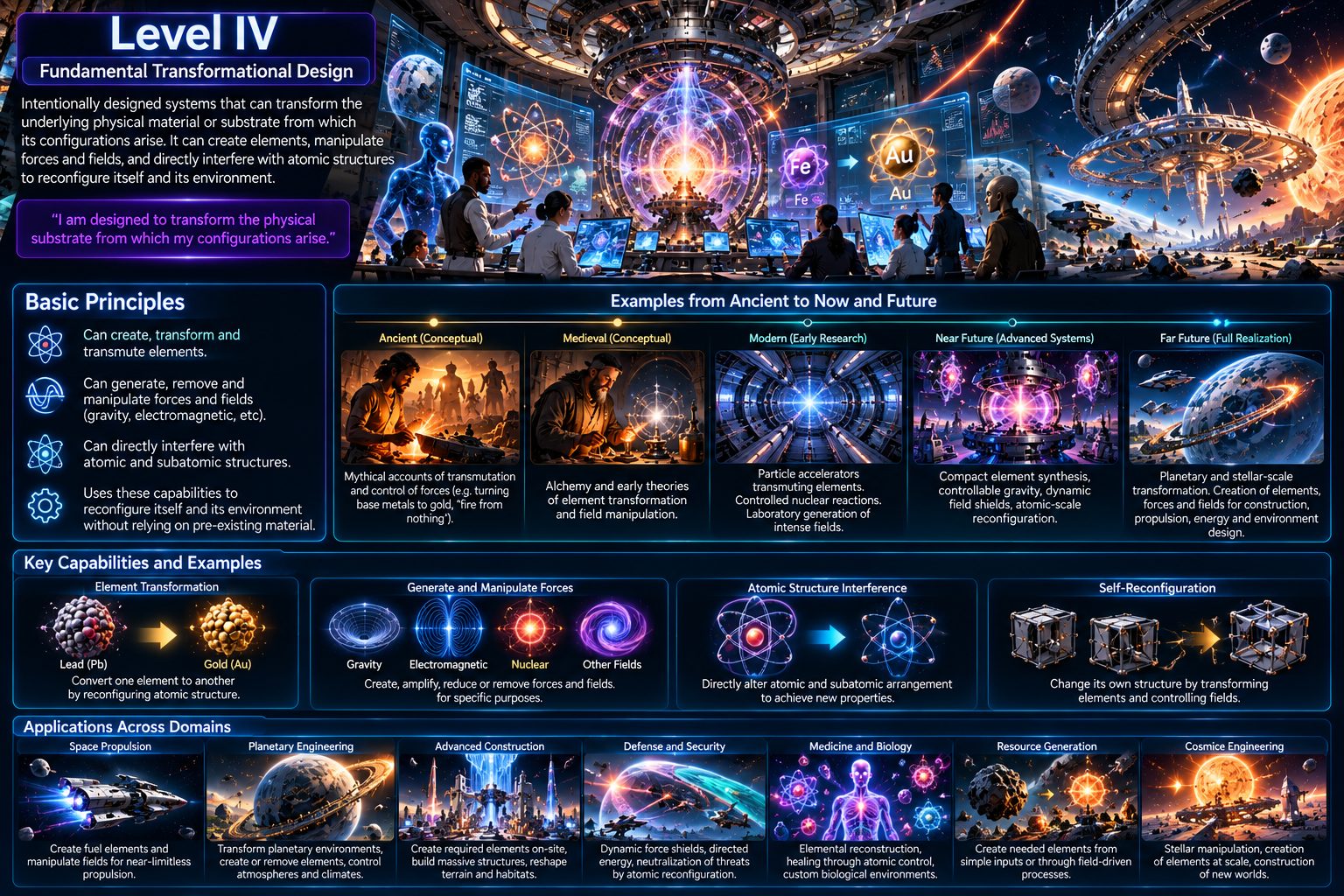
Level IV — Fundamental Transformational Design
Level IV goes deeper than generating new structures.
It concerns a system designed to transform the underlying physical material or substrate from which its configurations arise.

Its basic statement is:
“I am designed to transform the physical substrate from which my configurations arise.”

Consider a hypothetical spacecraft designed to travel through two radically different regions of space.
In one region, it encounters extremely high temperatures and radiation.
Its material configuration may need to withstand those conditions.
Later, it enters a very different environment, perhaps one dominated by extremely low temperatures or another physical constraint.
Instead of merely deploying another shield, imagine that the spacecraft can transform its material composition or physical basis into another configuration better suited to the new environment.
Conceptually:
Material configuration A ↓ fundamental transformation ↓ Material configuration B
For example, a future technology might deliberately transform its material from one elemental or structural composition into another.
This represents a much deeper transformation than unfolding an existing structure or manufacturing a new component.
The system is transforming what the structure is physically made from.
The Difference Between the Four Levels
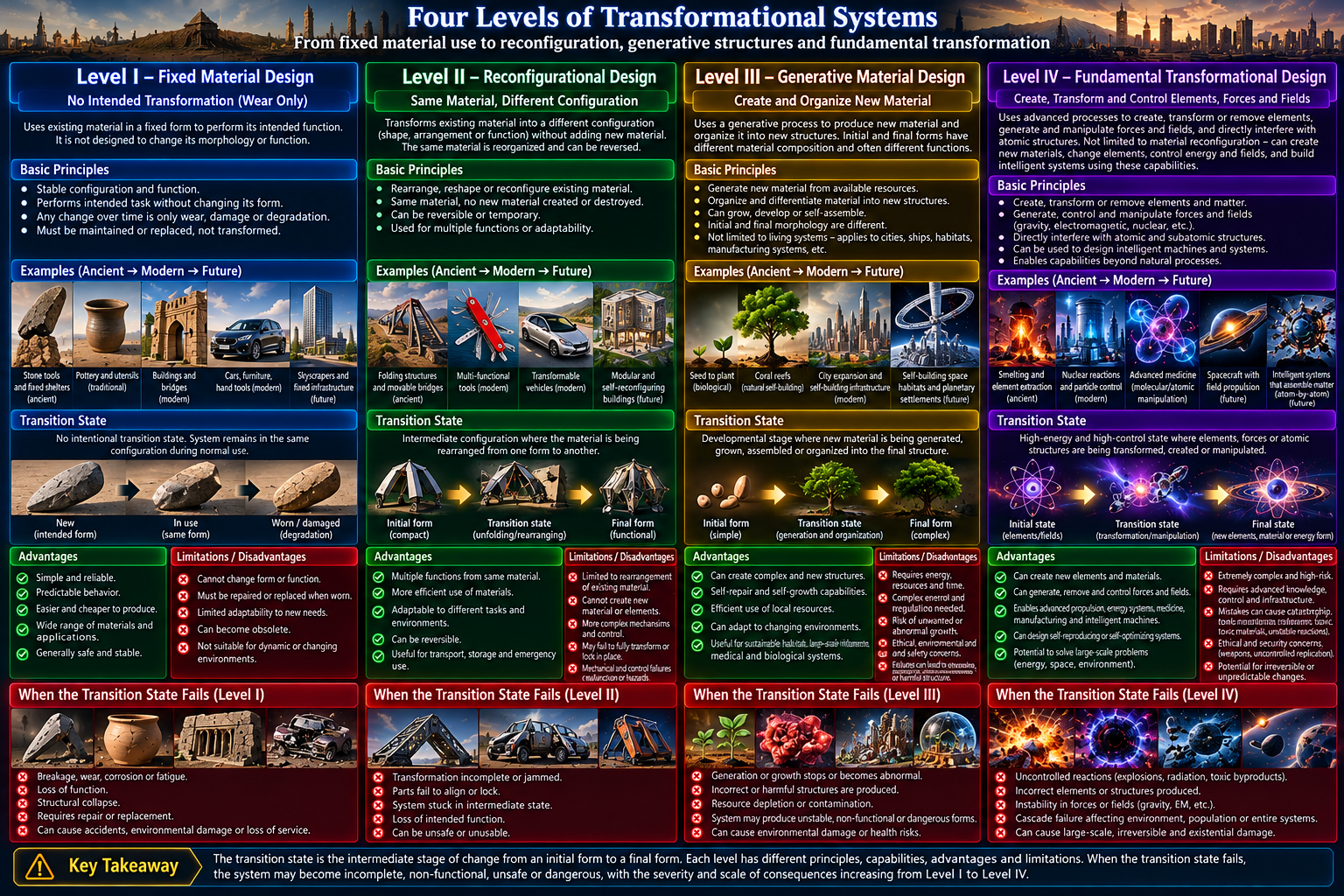
The four levels can therefore be understood as a progression:
LevelMaterial capabilityBasic ideaI — FixedMaintains its designed structureI am designed to be this.II — ReconfigurationalRearranges existing structuresI am designed to become this.III — GenerativeGenerates new material structuresI am designed to generate what I need to become this.IV — FundamentalTransforms the underlying physical substrateI am designed to transform what I am physically made of.
In its simplest form:
Level I — Possess. Level II — Rearrange. Level III — Generate. Level IV — Fundamentally transform.
The Destination Can Be Absent at the Beginning
One of the most important consequences of this framework is that the final morphology does not necessarily have to exist when the system is created.

At Level II, the destination configuration may exist as stored structures that have not yet been deployed.
At Level III, the destination structures may not yet exist at all. What exists is the generative capacity to produce them.
At Level IV, even the material basis of the future configuration may be different.
Therefore, design can extend beyond the present physical form of an object.
A design can specify not only what a system is, but what the system is intentionally capable of becoming.
The System-Level Principle
A higher-level capability in one component does not automatically make the entire system a higher-level design.
Imagine a Level II spacecraft that carries a small manufacturing machine.
The machine might be capable of producing a replacement component.
That alone does not make the entire spacecraft Level III.
For the spacecraft to qualify as Level III, generative material transformation must be part of the system's transformational architecture.
The system itself must be designed around the ability to generate the material structures required for its future configurations.
This prevents a system from being classified at a higher level merely because it contains one advanced component.
Pseudo-Levels
This leads to another concept: the Pseudo-Level Principle.
A system may display a limited capability associated with a higher level without actually possessing the complete architecture required for that level.
For example:
A Level II spacecraft contains a device capable of manufacturing a small component.
It exhibits a pseudo-Level III capability, but remains Level II if its overall design depends on rearranging existing structures rather than generating new structures as an integrated transformational process.
The distinction is therefore between:
having a higher-level capability somewhere inside the system
and
being designed as a higher-level transformational system.
Why This Concept Matters
Traditional design often asks:
What should we build?
Morphologically Disruptable Design asks an additional question:
What should the system be capable of becoming?
At Level III, the question becomes even deeper:
What should the system be capable of generating in order to become what it needs to be?
And at Level IV:
Can the system transform the physical basis from which its structures arise?
This changes the way we can think about future machines, spacecraft, biological systems and advanced materials.
A system no longer has to be understood only as a finished object.
It can be understood as a designed pathway through multiple physical states.

Conclusion
Morphologically Disruptable Design proposes that material systems can be classified according to the depth of transformation intentionally incorporated into their original design.
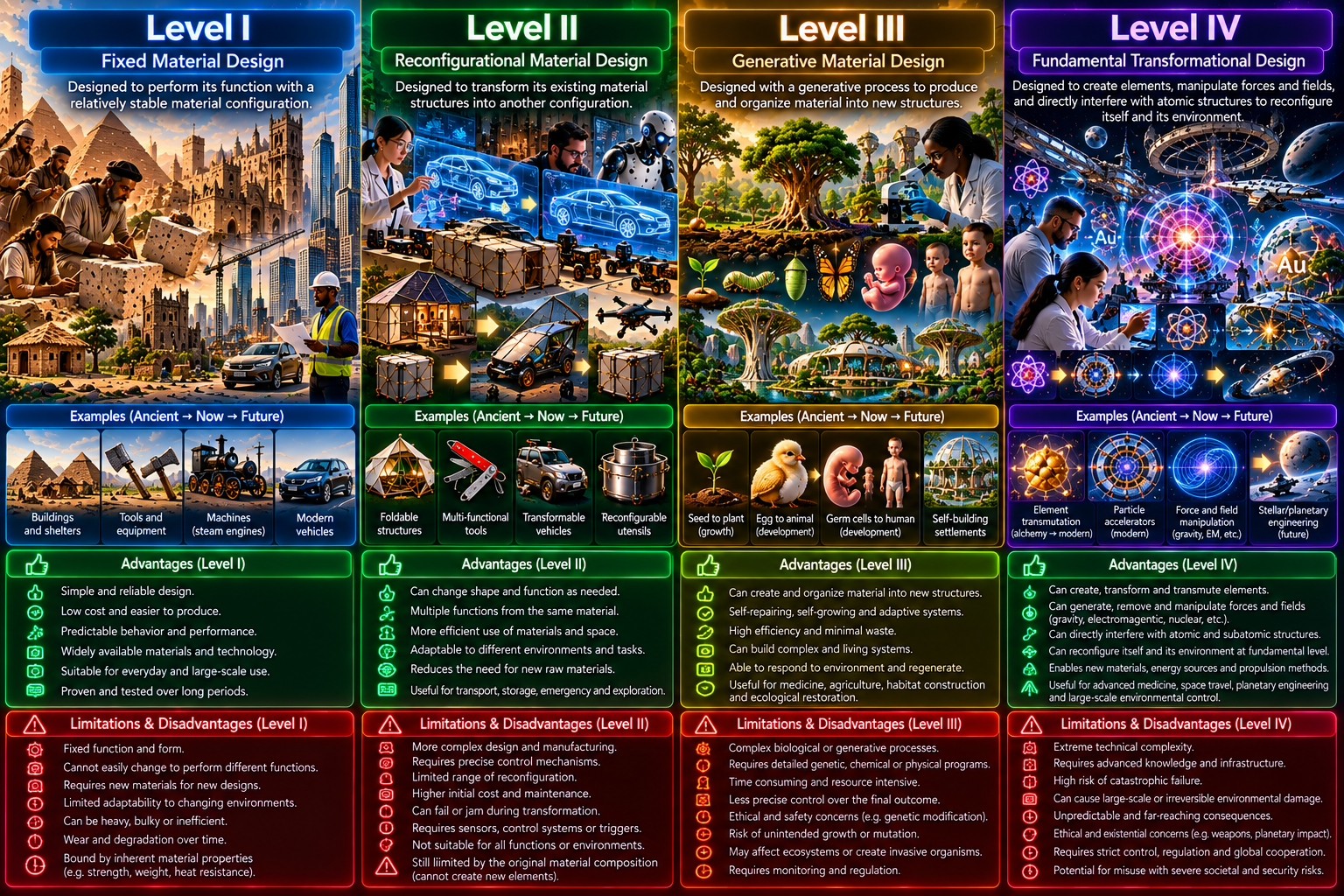
Level I designs a relatively stable material structure.
Level II designs the transformation of existing structures.
Level III designs the capacity to generate new material structures required for transformation.
Level IV extends the concept toward transformation of the underlying physical substrate itself.
The central question therefore changes from:
“What is this system designed to do?”
to:
“What is this system intentionally designed to become?”
And at higher levels:
“What is it designed to generate or transform in order to become it?”
The fundamental idea is simple:

Design does not have to end with the creation of a structure. Design can include the future morphology of the system itself.